| |||||||||||||||||||||||||
ARTBOOK BLOGEventsStore NewsMuseum Stores of the MonthNew Title ReleasesStaff PicksImage GalleryBooks in the MediaExcerpts & EssaysArtbook InterviewsEx LibrisAt First Sight2025 Gift GuidesFeatured Image ArchiveEvents ArchiveDATE 10/22/2026 McNally Jackson Seaport presents Tom Cole and Elliot Tuttle launching 'Chimes'DATE 10/14/2026 McNally Jackson Seaport presents David Jacob Kramer and Michael Schmelling launching 'Handmade Utopia'DATE 10/12/2026 Rizzoli Bookstore presents Ivan McClellan and Maria Soccor in conversation for the launch of 'Eight Seconds: Legacy in Motion'DATE 9/20/2026 Artbook | D.A.P. NYC Sample Sale at RodeoDATE 9/18/2026 Fall book events for Tom Cole's 'Chimes: A Monologue'DATE 9/17/2026 Long live idiosyncratic 'Hives!'DATE 9/16/2026 Artbook @ MoMA PS1 Bookstore talks and signings at Printed Matter's NY Art Book Fair 2026!DATE 9/16/2026 "The world has become too dangerous for anything less than Utopia" — Buckminster FullerDATE 9/15/2026 Honoring National Hispanic American Heritage MonthDATE 9/15/2026 The analogue allure of Socialist HotelsDATE 9/13/2026 The story of America's first major Black media empire through Barbara Karant's documentary lensDATE 9/12/2026 MASS MoCA R&D Store presents 'three six five' author Lucy Ives in conversation with Lauren Levato CoyneDATE 9/11/2026 In 'My ’90s Rock Photographs,' Melissa Auf der Maur plays witnesses to her own existence | STAFF PICKS | FROM THE SHELVES
| ||||||||||||||||||||||||




STATUS: Out of stock indefinitely. |
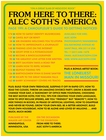
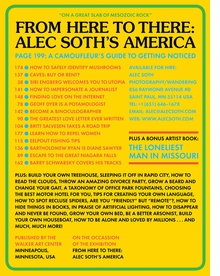 From Here to There: Alec Soth's America
Published by Walker Art Center.
Edited by Siri Engberg. Interview by Bartholomew Ryan. Text by Geoff Dyer, Barry Schwabsky, Britt Salvesen, Siri Engberg, August Kleinzahler.
From Here to There: Alec Soth's America is the first exhibition catalogue to feature the full spectrum of the work of Alec Soth, one of the most interesting voices in contemporary photography, whose compelling images of everyday America form powerful narrative vignettes. Featuring more than 100 of the artist's photographs made over the past 15 years, the book includes new critical essays by exhibition curator Siri Engberg, curator and art historian Britt Salvesen and critic Barry Schwabsky, which offer context on the artist's working process, the photo-historical tradition behind his practice and reflections on his latest series of works. Novelist Geoff Dyer's "Riverrun"--a meditation on Soth's series Sleeping by the Mississippi--and August Kleinzahler's poem "Sleeping It Off in Rapid City" contribute to the thoughtful exploration of this body of work. Also included in the publication is a 48-page artist's book by Soth titled The Loneliest Man in Missouri, a photographic essay with short, diaristic texts capturing the banality and ennui of middle America's suburban fringes, with their corporate office parks, strip clubs and chain restaurants. This full-color publication includes a complete exhibition history, bibliography and interview with the artist by Bartholomew Ryan.
Alec Soth was born in 1969 and raised in Minnesota, where he continues to live and work. He has received fellowships from the McKnight Foundation (1999, 2004) and Jerome Foundation (2001), was the recipient of the 2003 Santa Fe Prize for Photography and was short-listed for the highly prestigious Deutsche Börse Photography Prize. His first monograph, Sleeping by the Mississippi, was published in 2004 to critical acclaim. Since then Soth has published Niagara (2006), Fashion Magazine (2007), Dog Days, Bogotá (2007) and The Last Days of W (2008). He is a member of Magnum Photos.
PUBLISHER
Walker Art Center
BOOK FORMAT
Hardcover, 8 x 10 in. / 288 pgs / 150 color / 40 bw / 48 pg artist insert.
PUBLISHING STATUS
Pub Date 11/30/2010
Out of print
DISTRIBUTION
D.A.P. Exclusive
Catalog: FALL 2010 p. 177
PRODUCT DETAILS
ISBN 9780935640960 TRADE
List Price: $60.00 CAD $70.00 GBP £53.00
AVAILABILITY
Not available
STATUS: Out of print | 00/00/00 For assistance locating a copy, please see our list of recommended out of print specialists |


















|
the source for books on art & culture
CUSTOMER SERVICE
orders@artbook.com
929.642.0343 ext 207
M-F 10-6 EST
Ingram Customer Care
800-937-8200 option 3
orders@dapinc.com
NEW YORK
Showroom by Appointment Only
75 Broad Street, Suite 630
New York NY 10004
Tel 212 627 1999
LOS ANGELES
Showroom by Appointment Only
818 S. Broadway, Suite 700
Los Angeles, CA 90014
Tel. 323 969 8985
ARTBOOK LLC
D.A.P. | Distributed Art Publishers, Inc.
All site content Copyright C 2000-2025 by Distributed Art Publishers, Inc. and the respective publishers, authors, artists. For reproduction permissions, contact the copyright holders.

The D.A.P. Catalog
www.artbook.com