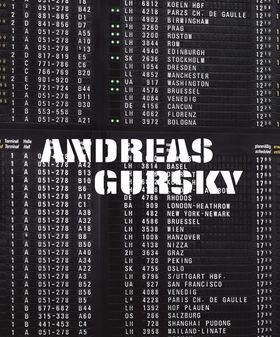
| Andreas Gursky: Works 80-08 Text by Martin Hentschel. "In all eras there have been artists who have aspired to encyclopedic summation of the world, to find a form to accommodate the mess," as Samuel Beckett once put it. The Renaissance marked the juncture >>more Hatje Cantz ISBN 9783775723381 US $60.00 CAN $72.00 TRADE Clth, 8 x 10 in. / 272 pgs / 174 color. Pub Date: 03/01/2009 Active/In stock Andreas Gursky: Architecture Edited by Sonja Fessel. Text by Ralf Beil, Aleida Assmann, Jan Assmann, Elisabeth Bronfen, Sonja Fessel, et al. A Japanese power plant, dilapidated slums, the patterned facades of an apartment complex in Paris--in the work of German art photographer Andreas Gursky, born in 1955 in Leipzig, both private dwellings and the domains of >>more Hatje Cantz ISBN 9783775721776 US $60.00 CAN $72.00 TRADE Hardback, 11.75 x 9.75 in. / 112 pgs / 75 color. Pub Date: 08/01/2008 Active/In stock Andreas Gursky Essay by Peter Galassi. Foreword by Glenn D. Lowry. The big, bold, seductive and surprising color photographs of German photographer Andreas Gursky set forth a stunning image of our contemporary world of high-tech industry, international markets, big-time sports, fast-paced tourism and slick commerce. Tra >>more The Museum of Modern Art, New York ISBN 9780870700163 US $65.00 CAN $78.00 TRADE Hardcover, 13.5 x 12 in. / 196 pgs / 115 color 18 duotone. Pub Date: 07/02/2002 Active/In stockOF RELATED INTEREST Andreas Gursky Essay by Peter Galassi. Foreword by Glenn D. Lowry. The big, bold, seductive and surprising color photographs of German photographer Andreas Gursky set forth a stunning image of our contemporary world of high-tech industry, international markets, big-time sports, fast-paced tourism and slick commerce. Tra >>more The Museum of Modern Art, New York ISBN 9780870700163 US $65.00 CAN $78.00 TRADE Hardcover, 13.5 x 12 in. / 196 pgs / 115 color 18 duotone. Pub Date: 07/02/2002 Active/In stock
BLOGFeatures and Themes of the Spring 2010 D.A.P. Catalog By Thomas EvansFor each season of the D.A.P. catalog, new themes and trends coalesce across the 600-odd titles announced therein, indicating emergent preoccupations and new areas of research in the arts. The Spring 2010 catalogue opens with an exciting and extremely significant culmination to that strain, in the form of The Museum of Modern Art's forthcoming appraisal of the female artists in its collection, Modern Women: Women Artists at The Museum of Modern Art. This volume, and the occasion of its publication, marks a bold move on MoMA's part to initiate a reassessment of its collection, and will no doubt encourage other institutions to follow suit...
In the current catalogue, another set of strengths emerges (not that it lacks for new monographs on neglected female artists--see forthcoming titles on Angelika Hoerle, Mercedes Matter, Lee Lozano, Unica Zürn and Birgit Jürgenssen). As always, the General Interest section boasts many 'books for life,' with ambitious and superbly produced monographs on Ed Ruscha, Yves Klein, Marina Abramovic, Francis Bacon (already shipping), Henri Cartier-Bresson, Botticelli, Burne-Jones, Rousseau, Renoir, Robert Doisneau, Edweard Muybridge, Walker Evans and others; each of these titles presents its own particular stack of reasons to anticipate its publication with excitement.
Photography monographs are clearly more than well represented on the Spring 2010 Books for Life shelf, but a particular emphasis falls this season on innovative group catalogues, with Aperture's groundbreaking tome on the Düsseldorf School (the three generations of photographers schooled by Bernd and Hilla Becher, including Andreas Gursky, Candida Höfer, Axel Hütte, Simone Nieweg, Thomas Ruff, Thomas Struth among others); Starburst, Hatje Cantz's fantastic survey of the color-photography boom of the 1970s, with William Eggleston, Stephen Shore, Joel Meyerowitz, Joel Sternfeld, William Christenberry, John Divola, Mitch Epstein and many others; and the Guggenheim's Haunted, which traces the presence and recurrence--the "haunting"--of contemporary photography and video art by specters of the past, in the form of defunct or outmoded technologies and subjects.
Publishers such as Metropolis and NAi are doing important work to publish imaginative responses to ever-more-pressing issues around climate change and sustainability, and the General Interest section contains several extremely innovative titles on this subject: an expanded edition of Fritz Haeg's bestselling "attack on the front lawn," Edible Estates, which includes several new projects and a manifesto by Will Allen, the founder of the famous Growing Power project in Wisconsin; Reading the American Landscape, an amazing and epic-scaled survey of the typologies and taxonomies of the American landscape, "from verandas to concert halls, individual plants to entire parks, highways to railroads, indoor exhibition spaces to public sculptures, desert horizons to secluded gardens"; On the Water, Guy Nordenson's sobering but imaginative exploration of the impact of rising currents on the New York and New Jersey shorelines; and two great titles from Hatje Cantz--Arium, which tackles the porousness and interaction between weather and architecture, and Migropolis, a psychogeographic survey of Venice's recent transformation under the twin pressures of climate change and tourism. A related publication in the Highlights section is Radical Nature, which collects utopian and ecological strategies devised by artists and architects from the 1960s to now, such as Buckminster Fuller, Joseph Beuys, Robert Smithson, Luke Fowler and others; also worth mentioning in relation to these titles are two impressive photography books on the collapse and decay of Detroit: Andrew Moore's Detroit Disassembled and Yves Marchand and Romain Meffre's The Ruins of Detroit.
D.A.P. has long supported publications on artist's books, and both books on artist's books and broader surveys of printed matter are notable presences in the Spring 2010 catalogue. The highlight title here must be JRP's In Numbers, edited by Andrew Roth and Philip Aarons, whose subtitle--"Serial Publications by Artists Since 1955"--both announces its premise and draws the reader into further inquiry. "Serial Publications" refers to publications by artists with innovative and prominent design qualities--publications that don't quite fit the 'artist's book' category, and several of which D.A.P. has distributed or does distribute in both original and facsimile editions: Wallace Berman's Semina, The Situationist Times, Joe Brainard's C Comics, General Idea's File magazine, Vito Acconci and Bernadette Mayer's 0-9, Provoke, the Fluxus annual boxes, Art-Language, North Drive Press, Donald Parsnips Daily Journal, LTTR, Permanent Food and many others. The publisher Primary Information has made a specialty of this realm, and this season will be issuing a timely facsimile edition of Willoughby Sharp and Liza Bear's Avalanche, the New York-based magazine that handed the critical reins over to artists and which was a crucial touchstone publication for American artists in the 1970s. Primary Information also brings us two further facsimile editions: Lee Lozano's best-known works, her notebooks, and Coffee Coffee, Aram Saroyan's influential collection of Concrete/Minimalist poems, first published by 0-9 in 1967. Other titles on artists' books include the first surveys of book works by Sol LeWitt and Olafur Eliasson, and Four Corners' wonderfully designed survey of Eduardo Paolozzi's text and collage contributions to Ambit magazine, The Jet Age Compendium. A D.A.P. staff favorite that cannot go unmentioned here is Ellsworth Kelly's Thumbing Through the Folder, which supplied the Highlights divider spread for this catalogue, and which is comprised of a conversation between Kelly and Hans Ulrich Obrist, interleaved with reproductions of collaged postcards by Kelly--a previously unseen and very charming body of work that is beautifully housed in this volume.
A large portion of our theory list this season also clusters around a common topic. "The Educational Turn" is an expression heard with increasing frequency in the art world, especially in art pedagogy and curatorial theory, and several titles address how art is studied, mediated, encountered and sold: Rethinking the Contemporary Art School, Curating and the Educational Turn, A Manual for the 21st Century Arts Institution, Arts in Society and The Murmuring of the Artistic Multitude. At the slightly friendlier end of our writings list, two strong new titles on Pop art deserve note: a much overhauled reprint of John Wilcock's The Autobiography and Sex Life of Andy Warhol, first published in 1971, and unique in its insider angle on the early days of Warhol's coterie and career. Publisher Chris Trela has worked hard to make this the book it should have originally been, and greatly expands our sense of the era and of Warhol himself by reprinting it. Published by MFA Publications, The Pop Revolution is the late Alice Goldfarb Marquis' social history
of Pop art--a group portrait," as she describes it, "of both the artists and the people who
made some of them rich and famous in just a few years, while setting in
motion the drastically altered way art has been marketed and
appreciated--in the monetary and aesthetic sense--up to the present day." This book is certainly as readable and as superbly written as her previous works on Duchamp and Clement Greenberg.
|
| | | | |