| |||||||||||||||||||||||||
ARTBOOK BLOGEventsStore NewsMuseum Stores of the MonthNew Title ReleasesStaff PicksImage GalleryBooks in the MediaExcerpts & EssaysArtbook InterviewsEx LibrisAt First Sight2025 Gift GuidesFeatured Image ArchiveEvents ArchiveDATE 10/31/2026 Halloween Horror, 2026DATE 10/24/2026 Artbook @ Hauser & Wirth Los Angeles Bookstore presents the LA launch of 'Inploration: Art Exploring Space to Understand Earth'DATE 10/23/2026 Plot presents 'jm: At the Age of 50, I Picked Up a Paintbrush Again'DATE 10/22/2026 McNally Jackson Seaport presents Tom Cole and Elliot Tuttle launching 'Chimes'DATE 10/17/2026 ICA Boston presents Melissa Auf der Maur in conversation with Naomi YangDATE 10/16/2026 Artbook @ Hauser & Wirth Los Angeles Bookstore presents Vanessa Beecroft & Chris Kraus celebrating 'Jane Bleibt Jane'DATE 10/15/2026 A refined history of Modernist cutlery in ‘Knife Fork Spoon’DATE 10/14/2026 A remarkable new book on Martin WongDATE 10/14/2026 McNally Jackson Seaport presents David Jacob Kramer and Michael Schmelling launching 'Handmade Utopia'DATE 10/13/2026 SOLD OUT! The Cooper Union presents the exhibition panel discussion 'Primers for a Handmade Utopia'DATE 10/13/2026 Anticapitalistic to their foundations: the 'Handmade Utopias' of Northern CaliforniaDATE 10/12/2026 Indigenous Peoples' Day Staff Picks, 2026DATE 10/12/2026 Rizzoli Bookstore presents Ivan McClellan and Maria Soccor in conversation for the launch of 'Eight Seconds: Legacy in Motion' | EVENTSCORY REYNOLDS | DATE 2/11/2014Now Available from the Cooper-Hewitt’s DesignFile eBook Series: 'Favelization' by Adriana KertzerIn Favelization, Adriana Kertzer sets out to understand the ways in which specific producers of contemporary Brazilian culture capitalized on misappropriations of the favela (informal squatter settlements that grow along the hillsides and lowlands of many Brazilian cities) in order to brand luxury items as "Brazilian." Kertzer analyzes the the works of artists and designers citing instances of engagement with primitivism and stereotype to make their goods more desirable to a non-Brazilian audience. The author further argues that the processes of interpretation, aestheticization, transcendence, and domination are part of the favelization phenomenon. Originally written by Kertzer as a thesis for Parsons The New School for Design's Masters program in the History of Decorative Arts and Design, Favelization locates design as part of a broader constellation of representations that includes a variety of forms, from printed media to film.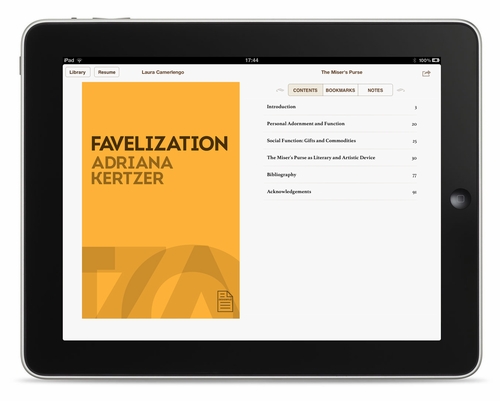  |