| |||||||||||||||||||||||||
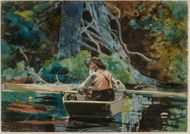
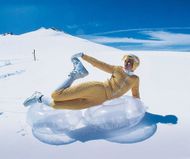
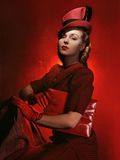
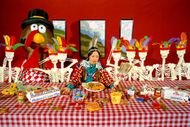
ARTBOOK BLOGEventsStore NewsMuseum Stores of the MonthNew Title ReleasesStaff PicksImage GalleryBooks in the MediaExcerpts & EssaysArtbook InterviewsEx LibrisAt First SightThe Artbook | D.A.P. 2025 Gift GuidesArtbook Featured Image ArchiveArtbook D.A.P. Events ArchiveDATE 1/1/2026 Happy New Year!DATE 12/25/2025 A revelation of our nation’s essential, quirky visual character in ‘Lee Friedlander: Christmas’DATE 12/16/2025 The acute gaze of Gabriele MünterDATE 12/11/2025 192 Books presents Raymond Foye and Peter Gizzi on The Song Cave's new edition of John Wiener’s 'Behind the State Capitol: Or Cincinnati Pike'DATE 12/9/2025 The atmospheric, rarely-seen watercolors of Winslow HomerDATE 12/8/2025 Pure winter glamour in ‘It’s Snowing!’DATE 12/3/2025 Flamboyant poses and melodramatic airs in 'Cecil Beaton's Fashionable World'DATE 11/30/2025 Artbook at Hauser & Wirth Los Angeles Bookstore presents Kelli Anderson and Claire L. Evans launching 'Alphabet in Motion'DATE 11/27/2025 Indigenous presence in 'Wendy Red Star: Her Dreams Are True'DATE 11/24/2025 Holiday Gift Guide 2025: Artful Crowd-PleasersDATE 11/22/2025 From 'Bottle Rocket' to 'The Phoenician Scheme' — the archives of Wes AndersonDATE 11/20/2025 The testimonial art of Reverend Joyce McDonaldDATE 11/18/2025 A profound document of art, love and friendship in ‘Paul Thek and Peter Hujar: Stay away from nothing’ | IMAGE GALLERY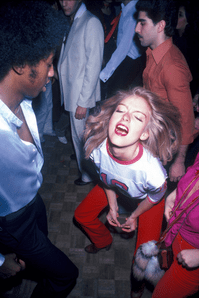 DATE 1/1/2026 Happy New Year!Tonight we’re gonna party like it’s 1977. “Studio 54,” by Waring Abbott, is from D.A.P. Best of 2025 Staff Pick I Hear Music in the Streets, ace photo editor Guillermo M. Ferrando’s cannot-put-it-down street photography collection, published by La Fábrica. Spanning the highly photogenic years 1969 to 1989, and touching down in every borough of the city, from the Bronx to Staten Island, this is a love letter to NYC subcultures, to music and to that ineffable, decisive moment in all great street photography. Featuring everyone from Andy Warhol to Susan Meiselas, Nan Goldin and Jamel Shabazz, it’s a book for every New Yorker with an eye or an ear for the people. “New York in the 1970s and 1980s, mythology has it, was a crumbling, crime-ridden, garbage-swamped disaster zone, a hellhole where nobody in their right mind would want to live,” essayist Tim Lawrence writes. “This version of New York history has been repeated so many times it’s become common sense. Yet the photos included in this book depict a city that, far from enduring a catastrophic and humiliating fall, brimmed with humanity, energy, even joy.”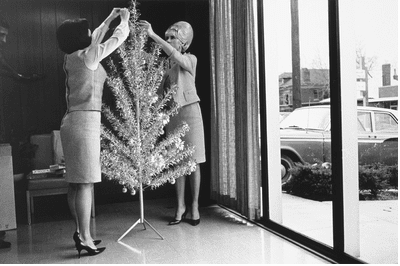 DATE 12/25/2025 A revelation of our nation’s essential, quirky visual character in ‘Lee Friedlander: Christmas’From our point of view, there really is no better take on the holiday. Published by Eakins Press Foundation in collaboration with the photographer, Lee Friedlander: Christmas collects more than 200 iconic / anti-iconic black-and-white photographs of whatever it is that we Americans collectively do to commemorate the giving season. It’s worth noting that, “while there is critique in these photographs, there is no moral judgment,” publisher Peter Kayafas writes. “While there are anecdotes that may embarrass the viewer, they are not the construct of the photographer so much as they exist in the eye of the beholder. If you can find the high holy celebration of the birth of Jesus Christ manifested here, more power to you. If what you see instead is a revelation of our nation’s essential, quirky visual character, then you’re the audience for this book.”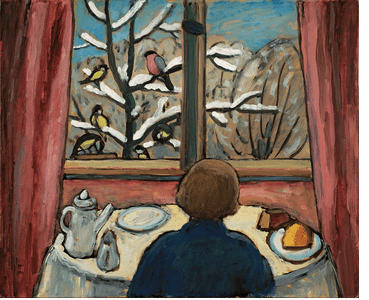 DATE 12/16/2025 The acute gaze of Gabriele MünterBreakfast of the Birds (Das Frühstück der Vögel) (March 10, 1934) is reproduced from Gabriele Münter: Contours of a World, published to accompany the landmark exhibition on view at Guggenheim Museum through April 2026. Long overlooked in favor of her male counterparts in the Blaue Reiter movement—which she actually cofounded—this major survey places Münter front and center among contemporaries like Wassily Kandinsky, her one-time romantic partner. “Misnomers of ‘naïve’ and ‘natural’ were applied to a practice that astutely interrogated concepts of identity and authenticity, form and color,” exhibition curator Megan Fontanella writes. “In the years 1908 to 1914, the artist’s still-life ‘experiments,’ as she called them, distinguished her production and helped establish Münter’s public identity. She reimagined the still life—historically characterized as among the so-called lesser academic pursuits—and, with her acute gaze, unlocked its potential for radical originality. In doing so, Münter challenged perceptions of both the genre and the capabilities of women artists with compositions that at once empower and disarm the viewer, transforming the ordinary into the remarkable.” |