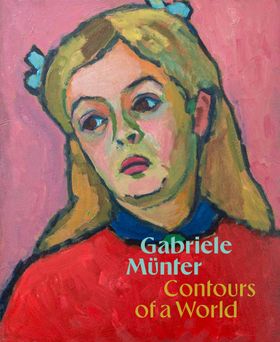
Edited with text by Megan Fontanella. Foreword by Mariët Westermann. Text by Victoria Horrocks, Isabelle Jansen, Iris Müller-Westermann, Dorothy Price.
A new look at a vanguard modernist artist who reimagined the still life, landscape and portrait genres
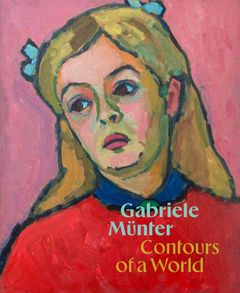
This landmark publication coincides with the major Guggenheim New York exhibition of works by the remarkable German Expressionist Gabriele Münter. Münter’s painting practice between 1908 and 1920 is the central focus of the exhibition and accompanying book. The study also illuminates her lesser-known later work and includes significant examples of her photography taken during earlier extensive travels in the United States. Münter was notably a cofounder of Der Blaue Reiter (The Blue Rider), a loose and transnational confederation of progressive artists and other creatives, with whom she probed the expressive potential of color and the symbolic resonance of forms. Her introspective portraits during World War II capture the “new woman” and explore questions of gender identity. Highlighting more than 90 paintings, drawings and photographs, this publication not only traces Münter’s pioneering and understudied practice but also challenges accepted historical narratives that have tended to sideline women artists. Reproductions of archival material appear alongside choice selections of the artist's sketches, prints and reverse glass paintings. Thematic texts by renowned scholars explore identity, place, belonging and the embodied experience of modernist women artists during this period. Gabriele Münter (1877–1962) was at the forefront of the German avant-garde in the early 20th century and exhibited extensively at galleries and salons throughout Europe during her lifetime. Along with her artistic colleague and one-time partner, Vasily Kandinsky, Münter was a founder of the influential Expressionist group of artists, Der Blaue Reiter.
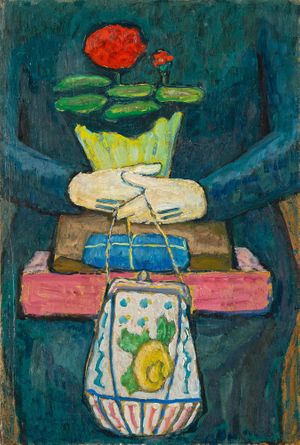
"Still Life on the Tram (After Shopping) (Stillleben in der Trambahn [Nach dem Einkauf])," ca. 1909–12. 'Gabriele Münter: Contours of a World,' published by Guggenheim Museum.
PRAISE AND REVIEWS
Art in America | Reframed
Kelly Presutti
This is a version of modern art without the outright aggression that so often accompanies it, though Münter was no less seriously engaged with questions of representation including radical innovations in form, composition, and color.
My Modern Met
Eva Baron
German Expressionist Gabriele Münter was a force to be reckoned with, standing at the forefront of her country’s avant-garde scene thanks to her introspective portraits, vivid landscapes, and illustrative forms....This expansive volume is not to be missed, especially given its focus on a trailblazing woman artist.
The New York Times
Martha Schwendener
[A] good survey that continues the important work of showcasing women and other marginalized figures who contributed to European modernism.
The Wall Street Journal
Judith H. Dobrzynski
Contours of a World' shows Munter as master of a delightful style, in each genre, that is more complicated than it looks—honest but always inventive.
The Financial Times
Ariella Budick
Münter, the star of a delicious Guggenheim retrospective titled 'Contours of a World,' periodically switched techniques, from finely wrought portraits to evocations of children’s drawings, to intricate formal experiments. Her sensibility and interests remained constant, though.
The Brooklyn Rail
Amanda Gluibizzi
Contours of a World' offers us an artist of some means and surprising independence.
The Brooklyn Rail
Ara H. Merjian
The exhibition sheds welcome light on Münter’s relatively understudied photographic practice, first pursued when she visited the United States in 1898 to visit extended family.
Hyperallergic
Natalie Haddad
What she accomplished is more radical than the subject matter suggests. Münter’s art is a masterclass in the phenomenological experience of seeing. Her images are windows into a scene, but her visual strategies redefine the static act of viewing art as something dynamic, as if her world is moving around us, demanding our perception to focus and refocus.
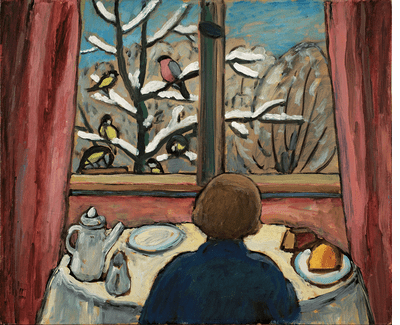
Breakfast of the Birds (Das Frühstück der Vögel) (March 10, 1934) is reproduced from Gabriele Münter: Contours of a World, published to accompany the landmark exhibition on view at Guggenheim Museum through April 2026. Long overlooked in favor of her male counterparts in the Blaue Reiter movement—which she actually cofounded—this major survey places Münter front and center among contemporaries like Wassily Kandinsky, her one-time romantic partner. “Misnomers of ‘naïve’ and ‘natural’ were applied to a practice that astutely interrogated concepts of identity and authenticity, form and color,” exhibition curator Megan Fontanella writes. “In the years 1908 to 1914, the artist’s still-life ‘experiments,’ as she called them, distinguished her production and helped establish Münter’s public identity. She reimagined the still life—historically characterized as among the so-called lesser academic pursuits—and, with her acute gaze, unlocked its potential for radical originality. In doing so, Münter challenged perceptions of both the genre and the capabilities of women artists with compositions that at once empower and disarm the viewer, transforming the ordinary into the remarkable.” continue to blog
FORMAT: Hbk, 8.75 x 10.75 in. / 176 pgs / 94 color / 66 b&w. LIST PRICE: U.S. $55.00 LIST PRICE: CANADA $77 GBP £48.00 ISBN: 9780892075690 PUBLISHER: Guggenheim New York AVAILABLE: 12/9/2025 DISTRIBUTION: D.A.P. RETAILER DISC: TRADE PUBLISHING STATUS: Active AVAILABILITY: In stock TERRITORY: WORLD
Published by Guggenheim New York. Edited with text by Megan Fontanella. Foreword by Mariët Westermann. Text by Victoria Horrocks, Isabelle Jansen, Iris Müller-Westermann, Dorothy Price.
A new look at a vanguard modernist artist who reimagined the still life, landscape and portrait genres
This landmark publication coincides with the major Guggenheim New York exhibition of works by the remarkable German Expressionist Gabriele Münter. Münter’s painting practice between 1908 and 1920 is the central focus of the exhibition and accompanying book. The study also illuminates her lesser-known later work and includes significant examples of her photography taken during earlier extensive travels in the United States. Münter was notably a cofounder of Der Blaue Reiter (The Blue Rider), a loose and transnational confederation of progressive artists and other creatives, with whom she probed the expressive potential of color and the symbolic resonance of forms. Her introspective portraits during World War II capture the “new woman” and explore questions of gender identity.
Highlighting more than 90 paintings, drawings and photographs, this publication not only traces Münter’s pioneering and understudied practice but also challenges accepted historical narratives that have tended to sideline women artists. Reproductions of archival material appear alongside choice selections of the artist's sketches, prints and reverse glass paintings. Thematic texts by renowned scholars explore identity, place, belonging and the embodied experience of modernist women artists during this period. Gabriele Münter (1877–1962) was at the forefront of the German avant-garde in the early 20th century and exhibited extensively at galleries and salons throughout Europe during her lifetime. Along with her artistic colleague and one-time partner, Vasily Kandinsky, Münter was a founder of the influential Expressionist group of artists, Der Blaue Reiter.