My Cart
Gift Certificates

ARTBOOK BLOG

RECENT POSTS

DATE 5/19/2026

Rizzoli Bookstore presents Pieter Henket and Justin Gaspar in conversation for the launch of 'Birds of Mexico City'

DATE 5/2/2026

Join Artbook | D.A.P. at CONTACT Photobook Fair, Toronto

DATE 5/1/2026

'Mathew Wong: Interiors' — radiating the light of dreams

DATE 4/25/2026

Artbook at Hauser & Wirth Los Angeles Bookstore presents Derek McCormack for the LA launch of 'The Shithole Opry Collector's Guide'

DATE 4/24/2026

Lost City Books presents Yumna Al-Arashi and Farrah Skeiky on 'Aisha'

DATE 4/23/2026

Garden passion and the passing of time

DATE 4/21/2026

‘Carol Bove’ is new from Guggenheim New York

DATE 4/20/2026

Mrs. Dalloway's Bookstore presents Jane Fulton Alt, Susan Page Tillett and James Baraz on 'Still Life'

DATE 4/20/2026

Rizzoli Bookstore presents Chris Wiley, Nan Goldin, and Robert Swope on 'Michel Hurst: Órale'

DATE 4/19/2026

Morbid Anatomy presents 'Divine Color' author Laura Weinstein on 'Gods in Living Color: Hindu Devotional Lithographs and the Birth of Modern Indian Visual Culture'

DATE 4/18/2026

Artbook @ MoMA PS1 Bookstore presents a Zine-Making Workshop with Lauren Simkin Berke

DATE 4/17/2026

Watershed moments in Australian Aboriginal modernism

DATE 4/17/2026

Spoonbill Books presents 'Aisha' author Yumna Al-Arashi in conversation with Céline Semaan


EXCERPTS & ESSAYS

MING LIN | DATE 6/29/2011

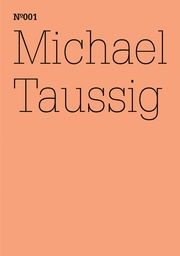
Documenta Notebooks: Michael Taussig, Fieldwork Notebooks

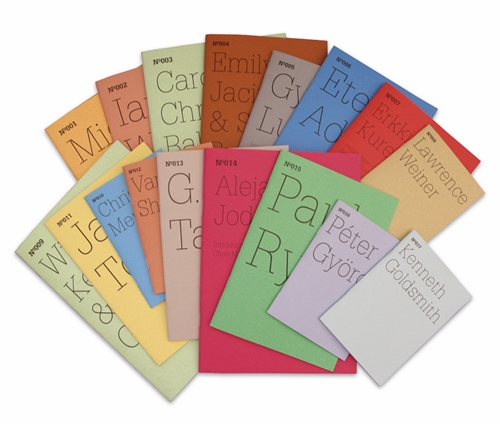
As a prelude to next year’s Documenta 13, Hatje Cantz and Documenta are issuing 100 Notes, 100 Thoughts, a Series of publications on notes and notetaking by artists, theorists and other creative minds. As a countdown to their August release, every week we will review a selection from the first 17 notebooks.
Documenta Notebooks: Michael Taussig, Fieldwork Notebooks
Meet Michael Taussig, a Colombia University professor recently hailed by The New York Times as a “class act,” for his eclectic approach to anthropological studies. Taussig has a background in medicine, but his practice draws from sources ranging from Marxism to magical realism. Often his work has been associated with the French Poststructuralist school that instigated a major shift in anthropology in the 1980s, where more subjective and literary ethnographies gained precedence over conventional styles of cultural analysis. Many of Taussig’s writings blend fact and fiction with results that might be likened to Werner Herzog's notion of 'ecstatic truth'--the idea that by exaggerating or amplifying one's account of reality a deeper truth can be revealed.

Taussig has repeatedly revisited Marx's concept of commodity fetishism. His ethnographies of Latin American culture have explored the ways in which western capitalism has affected the relationships people have to their material surroundings. He has portrayed the subjects of his studies as enlightened thinkers whose rituals and ceremonies reveal the implications of western economic ideologies, forcing the reader to re-situate his or her own quotidian reality. It has been said that the job of the anthropologist is to make the strange familiar and the familiar strange, and it is this sort of perverse method that informs Taussig’s narratives.

For his contribution, Taussig discusses the “phantom” of notetaking--that which arises when we reread the banal scribbles of our field notes or other forms of notetaking. The “phantom” is constituted by the traces of experience, those “interstices of notation" that cannot be jotted down, but which remain in the pages of the notebook nonetheless by their very absence. Taussig also discusses how notebooks become fetishized, citing biographical accounts of great thinkers that lovingly detail quality of paper, type of ink and so on. The notebook as an object is imbued with a mystical quality that enables the artist, writer, creator to execute his or her work with confidence and to encourage others to acquiesce to its authority. In light of this observation, Taussig once again demonstrates his knack for the subversive, positioning the fetish in this case as a tool that enables us to obtain information which might otherwise be obscured, and to verify facts which might not exist. "What irony," he writes in a moment of reflection, "that the anthropologist, namely myself, given to studying fetishism, should have unwittingly developed with his notebooks a fetish all of his own and become not only a slave to that fetish but enamored of it!"

Documenta Notebooks: Michael Taussig, Fieldwork Notebooks

Michael Taussig: Fieldwork Notebooks

Michael Taussig: Fieldwork Notebooks

Hatje Cantz
Pbk, 7 x 9.75 in. / 36 pgs / 1 color.