| RECENT POSTS DATE 10/22/2026 DATE 10/14/2026 DATE 9/20/2026 DATE 9/13/2026 DATE 9/12/2026 DATE 9/11/2026 DATE 9/11/2026 DATE 9/3/2026 DATE 8/30/2026 DATE 8/27/2026 DATE 8/25/2026 DATE 8/20/2026 DATE 8/20/2026
| | | ALIYAH TAYLOR | DATE 3/3/2014
Maria Lassnig occupied a singular role within the artistic movements of Vienna in the 1950s and 1960s, which included a loose association of writers, filmmakers, and visual artists at the vanguard of postwar Austrian culture. While Lassnig frequently engaged in lively exchanges with her counterparts, her work, which champions painting, draws from extensive subject matter, and defies categorization. In 1970, Lassnig had her first solo show in New York, but it wasn’t until 1993 with the exhibition Broken Mirrors, organized by Kaspar König and Hans Ulrich Obrist for the Vienna Festwochen and Deichtorhallen Hamburg, that she became celebrated internationally for a wide range of work, a rare genius for color, and a mastery of the subjective; Lassnig has devised a language to communicate memory. Though she was not granted immediate recognition, a difficulty attendant to many female artists, she persisted with unyielding dedication. In 1980, Lasnig became the first female painting professor at the Academy of Applied Arts in Vienna and the German-speaking world.
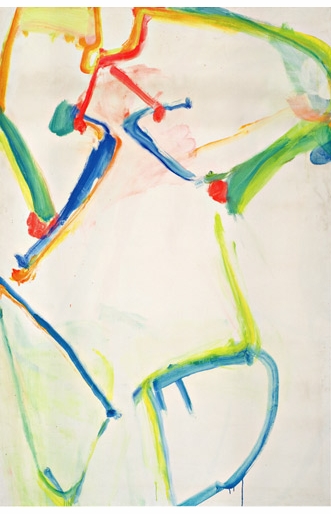
"Figur mit blauem Hals" (1961) is reproduced from Maria Lassnig: The Location of Pictures.
Performativity provided the impetus for Lassnig’s use of painting and drawing. Inspired by movements taking place in the cultural epicenters of Paris and New York where the artist was exposed to performance, dance, and film in the early stages of emergence, Lassnig later assigned the additional element of time to her experimentation with animation and film. Her artistic strategies mediate the phenomena located within and the objective without. By means of melding figure and abstraction, the corporeal components of Lassnig’s pictures reveal traces of endogenous events.
From the onset of her career, Lassnig has been steeped in the question of where pictures arise. Perception and the body are employed in her picture-producing systems, which deal with the emotional or subjective process of visualization. These systems unearth pictures from intimate awareness of the body. The German theorist and historian Hans Belting claimed that the notion of the picture was guided directly by the physical. Lassnig is an artist who has used her own body as an experimental venue—a site of event—not merely for situations but revelations.
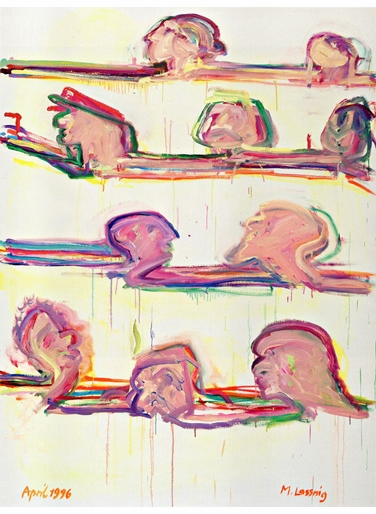
"Malfluss = Lebensfluss" (1996) is reproduced from Maria Lassnig: The Location of Pictures.
"I draw or paint a picture in a particular physical position, for example, sitting, leaning on one arm, you feel your shoulder blade; but of the arm itself only its upper position, the palm of the hand, like the handle of an invalid’s cane. […] on the face it’s hard to eliminate references to memory, because you see it in the mirror more often than the rest of the body, that’s why it almost always ends up more realistic.*”
Drawing from the borders of her periphery—physical and psychic—Lassnig activates an interior visual plane. Self-reflection is achieved in this manner without deploying external device. Her principal concerns are the picture’s role in semiotics, its function as representation of visual situations occurring in the mind’s eye; and, as articulated by the contemporary art historian Gottfried Boehm, the “affective process of becoming aware,” the impulse that extends to picture making. Sight perceives the outer world simultaneously as it perceives the body, by which the process of objectification occurs—self as object. Her body is the medium upon which the gaze is turned. In Lassnig's lurid paintings, she sets forth an organizational undertaking of the senses.
"Figur mit blouen Hols," (1961) is reproduced from Maria Lassnig: The Location of Pictures.
Maria Lassnig: Der Ort der Bilder or The Location of Pictures (available at ARTBOOK @ MoMA PS1 is the catalogue for a comprehensive examination of the artist’s oeuvre curated by Günther Holler-Schuster, who provides an extensive essay by the same title. The curator’s inclusion of various texts conveys Lassnig’s philosophy. The catalogue comprises a biographical timeline, an index of works exhibited, striking color reproductions of works on paper, works on canvas, film stills, and a dvd containing two 16 mm films, “Self Portrait” and “Iris”, tucked into a flap of the back cover. With a forward by Dirk Luckow and Peter Pakesch, a text by Gottfried Boehm, and a discussion between Oswald Weiner, who was central in the Vienna Group, and Silvia Eiblmayr, who contributes critical discourse to the feminist art historical context, the catalogue points to the living legacy of Maria Lassnig.
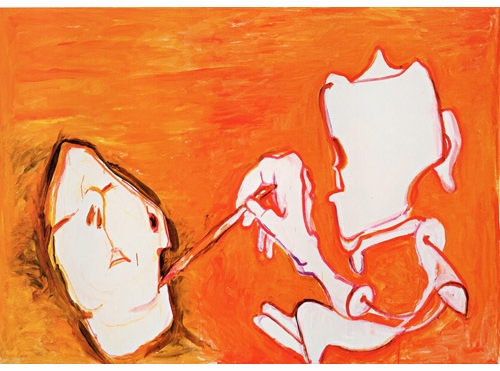
"Vom Tode gezeichnet" (2011) is reproduced from Maria Lassnig: The Location of Pictures.
Lassnig’s work will be on view March 9-May 25 at MoMA PS1. Focusing on her self-portraiture, the exhibition presents works by the artist—most of them never previously exhibited in the U.S.—from all creative periods of her career, spanning her early involvement with graphic abstraction in Paris and Art Informel, to her later shift to figural representation. The show will be the most significant survey of her work ever presented in the United States, featuring approximately 50 paintings drawn from public and private collections and the artist herself, as well as a selection of watercolors and filmic works.
*Obrist (ed.): Maria Lassnig: The Pen is the Sister of the Brush.
 Walther König, Köln
Pbk, 8.5 x 11 in. / 200 pgs / 80 color / 20 b&w.
| |
|