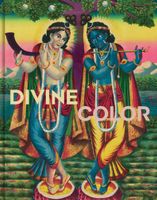
Edited with text by Laura Weinstein. Text by Mark Baron.
Transcendent and kaleidoscopic, these rare lithographs from colonial Calcutta helped forge the visual culture of modern India
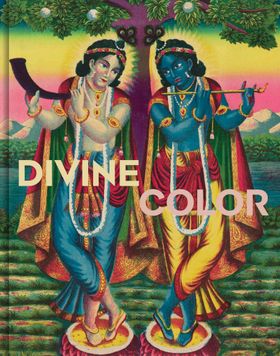
Under the rule of the British Raj, Bengali artists embraced European techniques not to mimic the West, but to devise a uniquely local visual language that appealed to a diverse audience. Divine Color magnifies this phenomenon through mapping the explosion of popular devotional art through lithographic printing in 19th- and early 20th-century Calcutta (now Kolkata), then the capital of British India. These vibrant and accessible mass-produced images brought the divine into everyday life, offering devotees new ways to engage with their gods, and reshaping spiritual experiences in colonial India. Set against the backdrop of a rapidly modernizing and cosmopolitan city, these prints emerged at the crossroads of vernacular tradition and colonial exchange. Their spirited aesthetic, devotional power and often political symbolism made them powerful tools of cultural expression and identity. The visual language pioneered by Calcutta lithographers played a foundational role in the formation of modern India's visual culture; their influence is visible in everything from advertising and political posters to decorative arts, underscoring the ritual, commercial and political power of these artworks. Divine Color restores these religious lithographs to their rightful place in the history of Indian art and invites readers to experience not just the divine world of Hindu gods, but the shaping of a modern visual India.
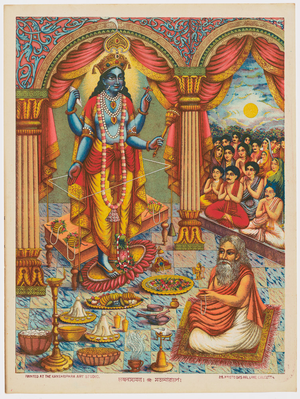
"Satyanarayan," about 1910, chromolithograph. Printed and published by Kansaripara Art Studio.
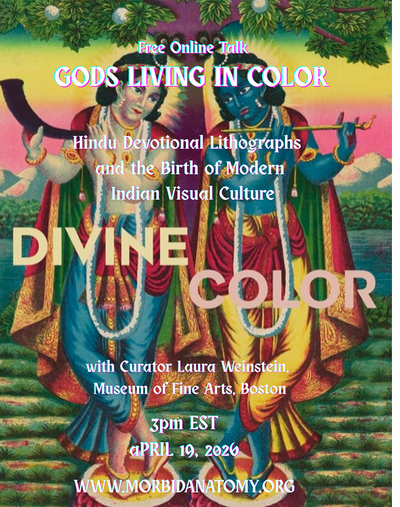
Sunday, April 19, from 3–4 PM EST, Morbid Anatomy presents a free online talk with Laura Weinstein, the Ananda Coomaraswamy Curator of South Asian and Islamic Art at the Museum of Fine Arts, Boston, to explore a transformative yet often overlooked chapter in South Asian art history: the explosion of popular devotional art through lithographic printing in nineteenth- and early twentieth-century Calcutta (now Kolkata). Sign up and RSVP here. continue to blog
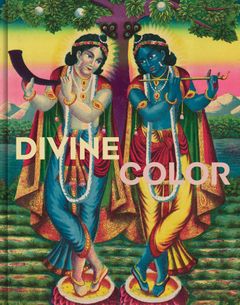
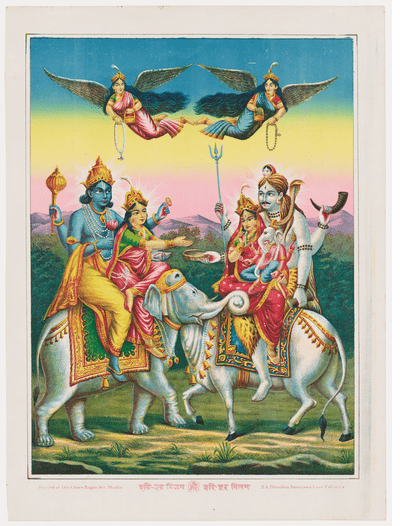
Published to accompany the exhibition currently on view at MFA Boston, Divine Color: Hindu Prints from Modern Bengal is a book unlike any other on our list. Filled with eye-popping, now-rare but once mass-produced vernacular religious lithographs from 19th- and early 20th-century Kolkata—aka colonial Calcutta—it shows how Bengali artists insisted upon and represented their own religious traditions and icons, while incorporating new printing techniques from the west. Pictured here, “Hari Hara Milan (Union of Shiva and Vishnu),” produced around 1895–1910 by Chore Bagan Art Studio. It’s an example of the “rainbow roll” printmaking technique that became popular among local presses, where several colors of ink were blended on a roller to create a seamless, dynamic, almost psychedelic gradient behind traditional compositions. The print depicts “an encounter between Shiva and Vishnu, each riding an animal mount and accompanied by his consort,” according to curator Laura Weinstein. “The heads of Vishnu’s elephant and Shiva’s bull merge in a visual trick with roots in South Asian art over a millennium old. While the chromolithograph resembles an earlier version by Calcutta Art Studio, certain iconographic and stylistic changes are evident. Most notably, the blue-gray sky with puffy white clouds has been replaced by a candy-colored rainbow roll.” continue to blog
FORMAT: Hbk, 8.25 x 10.5 in. / 144 pgs / 80 color. LIST PRICE: U.S. $45.00 LIST PRICE: CANADA $63 GBP £38.00 ISBN: 9780878469086 PUBLISHER: MFA Publications, Museum of Fine Arts, Boston AVAILABLE: 3/3/2026 DISTRIBUTION: D.A.P. RETAILER DISC: TRADE PUBLISHING STATUS: Active AVAILABILITY: In stock TERRITORY: WORLD
Published by MFA Publications, Museum of Fine Arts, Boston. Edited with text by Laura Weinstein. Text by Mark Baron.
Transcendent and kaleidoscopic, these rare lithographs from colonial Calcutta helped forge the visual culture of modern India
Under the rule of the British Raj, Bengali artists embraced European techniques not to mimic the West, but to devise a uniquely local visual language that appealed to a diverse audience. Divine Color magnifies this phenomenon through mapping the explosion of popular devotional art through lithographic printing in 19th- and early 20th-century Calcutta (now Kolkata), then the capital of British India. These vibrant and accessible mass-produced images brought the divine into everyday life, offering devotees new ways to engage with their gods, and reshaping spiritual experiences in colonial India.
Set against the backdrop of a rapidly modernizing and cosmopolitan city, these prints emerged at the crossroads of vernacular tradition and colonial exchange. Their spirited aesthetic, devotional power and often political symbolism made them powerful tools of cultural expression and identity. The visual language pioneered by Calcutta lithographers played a foundational role in the formation of modern India's visual culture; their influence is visible in everything from advertising and political posters to decorative arts, underscoring the ritual, commercial and political power of these artworks. Divine Color restores these religious lithographs to their rightful place in the history of Indian art and invites readers to experience not just the divine world of Hindu gods, but the shaping of a modern visual India.