Edited with text by Katherine Jentleson. Foreword by Rand Suffolk. Text by Kim Conaty, María Elena Ortiz, Elizabeth Penton, Wayne Evans.
Visionary self-taught Southern folk artist Minnie Evans receives a long overdue encore of her mystical, divinely inspired drawings
Published with High Museum of Art.
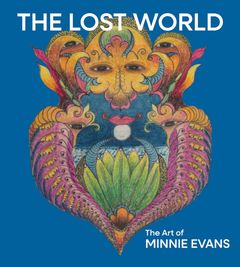
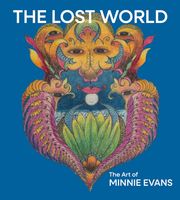
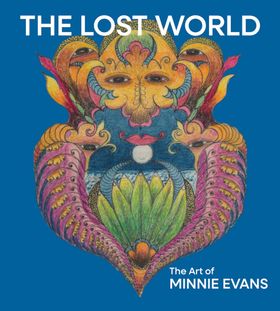
American artist Minnie Evans (1892–1987) once said her drawings of harmoniously intertwined human, botanical and animal forms came from visions of "the lost world," or nations destroyed by the Great Flood as described in the Book of Genesis. As the visions she experienced in childhood became stronger, Evans produced a large body of work ranging from abstract to representational styles. When she turned 56, she transitioned from decades of employment as a domestic worker to collecting admissions at Airlie Gardens in Wilmington, North Carolina. She made art during idle moments and hung it on and near the Gardens' wrought-iron gate. Selling or giving away her drawings to visitors led to a wider reputation and eventually a 1966 exhibition at a New York church titled The Lost World of Minnie Evans. This publication reprises that 1966 title, honoring Evans' interest in biblical and ancient civilizations while foregrounding the spiritual and historical circumstances of her extraordinary life. More than 100 of her artworks are presented in a range of contexts, from the extrasensory experiences of her visions to the double-edged realities of her life in the Jim Crow South. Her drawings, beautiful and complex, thus become portals into her "lost world."
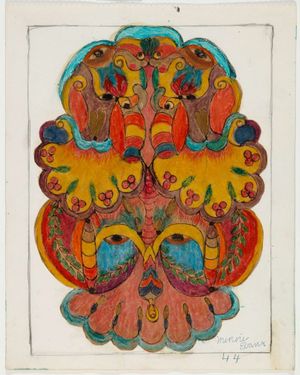
"Untitled (Scalloped Forms)" (1944) is reproduced from 'The Lost World: The Art of Minnie Evans,' published by DelMonico Books / High Museum of Art.
PRAISE AND REVIEWS
Art in America | Reframed
TK Smith
The retrospective offers us a chance to sidestep othering narratives from the past and consider her work on its own terms.
The New York Times
Elisa Gabbert
[Skillings’s] poems read a bit like absurdist theater set in a haunted dollhouse.
Colossal
Kate Mothes
Evans was among the first Black artists to have a solo exhibition at the Whitney Museum of American Art in New York, and 'The Lost World' marks the first major presentation of her work in about three decades.
Hyperallergic
Lakshmi Rivera Amin
[This] catalog offers a luminous glimpse into the countless drawings Evans crafted by fusing her spiritual visions with quotidian experiences in the American South and inspiration drawn from lush Airlie Gardens, where she worked for over 25 years.
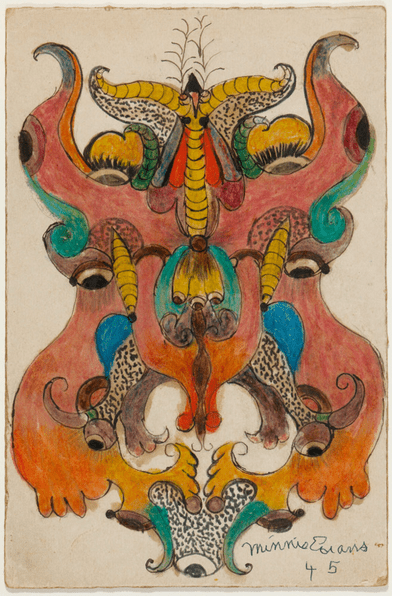
Untitled (Many-Eyed Form) (1945) is reproduced from new release The Lost World: The Art of Minnie Evans, published to accompany the exhibition on view now at Atlanta’s High Museum of Art. The first major survey of Evans’ divinely inspired works on paper since the 1990s, this is, amazingly, the only book in print on this important self-taught artist. “In March 1971,” curator Katherine Jentleson writes, “Minnie Evans sat for a rare interview with Celestine Ware, a Black feminist author and activist. At the time, Ware was producing a radio series on Black women artists, and she’d become fascinated by the work of Evans, who was still four years shy of her breakthrough solo show at the Whitney Museum of American Art but increasingly well known outside her home¬town of Wilmington, North Carolina. ‘What is the lost world of Minnie Evans?’ Ware asks near the end of the interview. Initially, Evans appears reluctant to answer: ‘I don’t know about that,’ she demurs. But Ware continues to press, and eventually, Evans relents, explaining that she has been experiencing visions her entire life, including ones involving the Great Flood described in the Book of Genesis. ‘Nations have been destroyed,’ she says. ‘And a lot of [the] pictures that God has given me [he’d] brought back from different nations […] according to the Bible there is thousands of nations that’s been destroyed and nobody knew anything about them.’” continue to blog
FORMAT: Hbk, 9.75 x 10.75 in. / 192 pgs / 157 color / 17 b&w. LIST PRICE: U.S. $45.00 LIST PRICE: CANADA $63 GBP £38.00 ISBN: 9781636812199 PUBLISHER: DelMonico Books AVAILABLE: 1/6/2026 DISTRIBUTION: D.A.P. RETAILER DISC: TRADE PUBLISHING STATUS: Active AVAILABILITY: In stock TERRITORY: WORLD
Published by DelMonico Books. Edited with text by Katherine Jentleson. Foreword by Rand Suffolk. Text by Kim Conaty, María Elena Ortiz, Elizabeth Penton, Wayne Evans.
Visionary self-taught Southern folk artist Minnie Evans receives a long overdue encore of her mystical, divinely inspired drawings
Published with High Museum of Art.
American artist Minnie Evans (1892–1987) once said her drawings of harmoniously intertwined human, botanical and animal forms came from visions of "the lost world," or nations destroyed by the Great Flood as described in the Book of Genesis. As the visions she experienced in childhood became stronger, Evans produced a large body of work ranging from abstract to representational styles. When she turned 56, she transitioned from decades of employment as a domestic worker to collecting admissions at Airlie Gardens in Wilmington, North Carolina. She made art during idle moments and hung it on and near the Gardens' wrought-iron gate. Selling or giving away her drawings to visitors led to a wider reputation and eventually a 1966 exhibition at a New York church titled The Lost World of Minnie Evans.
This publication reprises that 1966 title, honoring Evans' interest in biblical and ancient civilizations while foregrounding the spiritual and historical circumstances of her extraordinary life. More than 100 of her artworks are presented in a range of contexts, from the extrasensory experiences of her visions to the double-edged realities of her life in the Jim Crow South. Her drawings, beautiful and complex, thus become portals into her "lost world."