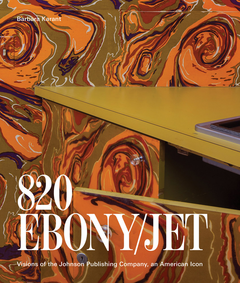
Visions of the Johnson Publishing Company, an American Icon
Foreword by Deborah Willis. Text by Aaron Bryant, Cheryl Finley, Brenna Greer, Jon Ott, E. James West, Carla Williams.
Residual textures, patterns and structures of the abandoned Ebony and Jet offices represent both the spirit of a Black publishing empire and the sense of its loss
This book by photographer Barbara Karant commemorates the Johnson Publishing Company, publisher of the iconic Ebony and Jet magazines and the most influential Black-owned media corporation of its day. Karant spent more than three years documenting the company’s historic building at 820 S. Michigan Avenue in downtown Chicago, capturing the last vestiges of the original workspace after the company sold the building in 2010 and relocated in 2012. These vibrant interiors, which remained largely unchanged from 1972 to 2012, fostered the creativity of a staff working in a variety of media. Each floor of the 11-story building flaunted distinct color and pattern combinations, and its bold, contemporary design telegraphed JPC’s position at the forefront of Black American business and culture. Stripped of its furnishings, the interiors of the former JPC headquarters simultaneously represent the spirit of this landmark company and the sense of its loss, of a seminal moment in Black American history and the history of this nation. Accompanying the approximately 125 color photographs by Karant are documentary images of the original interiors, along with other archival material. A foreword by Deborah Willis and essays by Aaron Bryant, Cheryl Finley, Carla Williams, Jon Ott, Brenna Wynn Greer, and E. James West address JPC’s dominance as an image and tastemaker in mid- to late-20th century America, the landscape of American Black media, the Ebony in-house photo studio, and the site-specific lobby sculpture by Richard Hunt. Short texts by former employees who worked in the building contribute important documentation to JPC’s history. 820 Ebony/Jet is a tribute to the achievements of this remarkable American company.
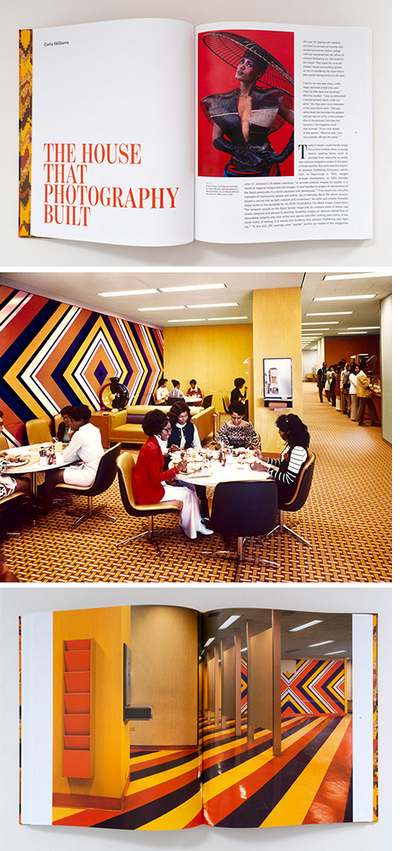
Spreads and detail are reproduced from new release, 820 Ebony/Jet, Chicago photographer Barbara Karant's documentary love-letter to the onetime home of the Johnson Publishing Company—publisher of Ebony and Jet, among many other Black culture magazines, but also incubator and herald of all things Black-empowered and Black-generated. "Distinct colors and patterns gave each floor its own personality," Aaron Bryant writes of this 1971 landmark, designed by Chicago architect John Moutoussamy and styled by Palm Springs interior designers Arthur Elrod and William Raiser under the creative direction of John and Eunice Johnson. "Geometric abstractions and pulses of psychedelic colors also seemed inspired by the textiles of post-colonial diasporas. The result was, as architectural writer and photographer Lee Bey described, 'an exuberant, high-style and fearless mix of color, texture, art, contemporary furnishings and pattern' that were 'a perfect match for publisher John H. Johnson's groundbreaking magazines.' The interior mirrored a contemporary blend of African and American styles that conveyed a new vision of the African American past, present and future. Bright colors, ethnically inspired patterns and 1970s futurism produced a post–civil rights 'Afropolitan' modernism. Further, open and shared spaces created a corporate environment for building a community and culture of collaboration." Pictured here, a spread featuring Grace Jones, photographed by Moneta Sleet, Jr., for the May 16, 1983, issue of Jet; the cafeteria, where employees ate for only $1.00 a day, photographed for Ebony in 1972; a spread featuring Karant's photograph Floor 10 #6, taken between 2010 and 2012, after the company had relocated. continue to blog
FORMAT: Hbk, 9.25 x 11 in. / 240 pgs / 140 color / 8 b&w. LIST PRICE: U.S. $65.00 LIST PRICE: CANADA $90 GBP £54.00 ISBN: 9781969303043 PUBLISHER: MW Editions AVAILABLE: 9/29/2026 DISTRIBUTION: D.A.P. RETAILER DISC: TRADE PUBLISHING STATUS: Active AVAILABILITY: In stock TERRITORY: WORLD
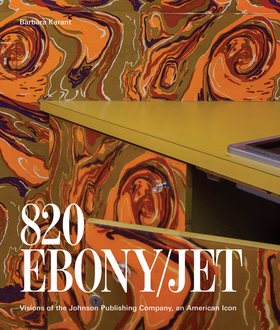
820 Ebony/Jet Visions of the Johnson Publishing Company, an American Icon
Published by MW Editions. Foreword by Deborah Willis. Text by Aaron Bryant, Cheryl Finley, Brenna Greer, Jon Ott, E. James West, Carla Williams.
Residual textures, patterns and structures of the abandoned Ebony and Jet offices represent both the spirit of a Black publishing empire and the sense of its loss
This book by photographer Barbara Karant commemorates the Johnson Publishing Company, publisher of the iconic Ebony and Jet magazines and the most influential Black-owned media corporation of its day. Karant spent more than three years documenting the company’s historic building at 820 S. Michigan Avenue in downtown Chicago, capturing the last vestiges of the original workspace after the company sold the building in 2010 and relocated in 2012. These vibrant interiors, which remained largely unchanged from 1972 to 2012, fostered the creativity of a staff working in a variety of media. Each floor of the 11-story building flaunted distinct color and pattern combinations, and its bold, contemporary design telegraphed JPC’s position at the forefront of Black American business and culture. Stripped of its furnishings, the interiors of the former JPC headquarters simultaneously represent the spirit of this landmark company and the sense of its loss, of a seminal moment in Black American history and the history of this nation.
Accompanying the approximately 125 color photographs by Karant are documentary images of the original interiors, along with other archival material. A foreword by Deborah Willis and essays by Aaron Bryant, Cheryl Finley, Carla Williams, Jon Ott, Brenna Wynn Greer, and E. James West address JPC’s dominance as an image and tastemaker in mid- to late-20th century America, the landscape of American Black media, the Ebony in-house photo studio, and the site-specific lobby sculpture by Richard Hunt. Short texts by former employees who worked in the building contribute important documentation to JPC’s history. 820 Ebony/Jet is a tribute to the achievements of this remarkable American company.