By Eric Lusito. Edited by Damon Murray, Stephen Sorrell. Introduction by Paul Josephson.
Cosmic rays and rumored climate-altering weapons—a treasure trove of never-before-documented Soviet-era research sites
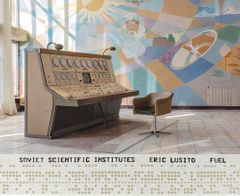
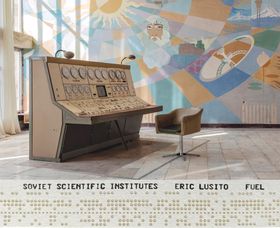
In Soviet Scientific Institutes, French photographer Eric Lusito (born 1976) takes readers on a journey through time, space and science. Gigantic control panels, monumental telescopes, inexplicable machinery—the facilities he documents might be found in comic book and graphic novel fantasies or the science fiction of Jules Verne and H.G. Wells. But why were these institutes built and what purposes do they serve today? The Soviets promoted science as a utopian ideal to replace religion and rapidly modernize the country. "Big science" projects, primarily for Cold War military purposes, involved thousands of researchers working in complete secrecy. In the 1990s, after the collapse of the Soviet Union, many institutes were left destitute, their sophisticated technology condemned to extinction. But some scientists persevered, adapting to the new landscape. Today, defying the odds, they persist—even in wartime—to continue their work. Lusito gained unique access to sites across former republics and satellites of the USSR—from a cosmic ray research center in the remote Armenian mountains, to one of the world's largest radars located in Ukraine, which locals believed to be a climate-altering weapon. Featuring a cover with a tactile laser-cut pattern replicating the punched paper tape used by early Soviet computers, Soviet Scientific Institutes is the first visual account of this once-closed world. Lusito's photographs capture the unintentional and unexpected beauty of scientific technology and bear witness to our never-ending quest for knowledge.
PRAISE AND REVIEWS
Wallpaper*
Jonathan Bell
The twin fascinations of fallen Empire and urban exploration collide in photographer Eric Lusito’s new book, 'Soviet Scientific Institutes.' A visual essay chronicling the catastrophic decline in funding and research in the post-Soviet era, Lusito’s camera takes us on a fascinating tour of the faded relics of communism’s utopian and authoritarian grip on the country’s scientific endeavours.
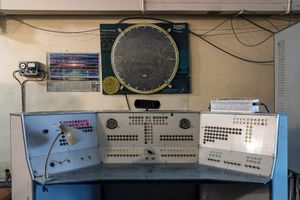
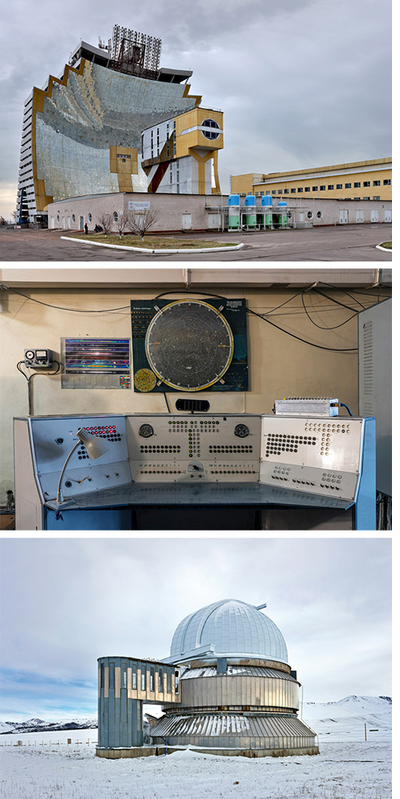
Behold, the reality of yesteryear’s Soviet Scientific Institutes, as documented by French photographer Eric Lusito in this newest release in FUEL’s acclaimed series on Soviet architectural relics. Housed in a tactile hardcover with laser-cut patterns based on antiquated, punched-paper computer tape, the volume spans the Baltic nations, Ukraine, Central Asia and East Central Europe, but does not include sites in territories that are still under authoritarian rule: Russia, Azerbaijan and Belarus. Pictured here: the Big Solar Furnace of the Institute of Materials Science, Academy of Sciences of Uzbekistan, comprised of 10,700 mirrors that focus light from an array of heliostats onto a single focal point; the Carl Zeiss telescope pavilion in Kazakhstan, opened in 1981 and currently under reconstruction; and the Ukrainian T-Shaped Radio Telescope (Second Modification) antenna control panel a few weeks before the 2022 Russian invasion. continue to blog
FORMAT: Hbk, 8 x 6.5 in. / 208 pgs / 180 color. LIST PRICE: U.S. $34.95 LIST PRICE: CANADA $48.95 ISBN: 9781068294600 PUBLISHER: FUEL AVAILABLE: 5/19/2026 DISTRIBUTION: D.A.P. RETAILER DISC: TRADE PUBLISHING STATUS: Active AVAILABILITY: In stock TERRITORY: NA ONLY
Published by FUEL. By Eric Lusito. Edited by Damon Murray, Stephen Sorrell. Introduction by Paul Josephson.
Cosmic rays and rumored climate-altering weapons—a treasure trove of never-before-documented Soviet-era research sites
In Soviet Scientific Institutes, French photographer Eric Lusito (born 1976) takes readers on a journey through time, space and science. Gigantic control panels, monumental telescopes, inexplicable machinery—the facilities he documents might be found in comic book and graphic novel fantasies or the science fiction of Jules Verne and H.G. Wells. But why were these institutes built and what purposes do they serve today?
The Soviets promoted science as a utopian ideal to replace religion and rapidly modernize the country. "Big science" projects, primarily for Cold War military purposes, involved thousands of researchers working in complete secrecy. In the 1990s, after the collapse of the Soviet Union, many institutes were left destitute, their sophisticated technology condemned to extinction. But some scientists persevered, adapting to the new landscape. Today, defying the odds, they persist—even in wartime—to continue their work.
Lusito gained unique access to sites across former republics and satellites of the USSR—from a cosmic ray research center in the remote Armenian mountains, to one of the world's largest radars located in Ukraine, which locals believed to be a climate-altering weapon. Featuring a cover with a tactile laser-cut pattern replicating the punched paper tape used by early Soviet computers, Soviet Scientific Institutes is the first visual account of this once-closed world. Lusito's photographs capture the unintentional and unexpected beauty of scientific technology and bear witness to our never-ending quest for knowledge.