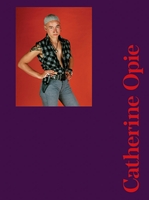
Edited by Catherine Opie, Clare Freestone. Text by Joan Didion, Clare Freestone, Magdalene Keaney, Mark Godfrey, Alistair O'Neil.
Thirty-plus years of Opie's stylized investigations of identity and social belonging through portraiture
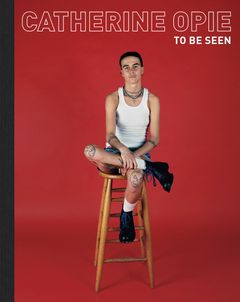
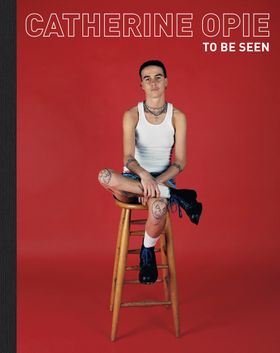
This publication accompanies a major survey at the National Portrait Gallery, spanning the entirety of American photographer Catherine Opie's career. At the core of Opie's work is a persistent exploration of society's evolving ideas regarding community, identity and belonging, especially within the LGBTQ+ community. Opie's wide-ranging portraits include intimate studio shots of friends and figures, capturing moments of vulnerability, pride and resilience. Alongside these, she creates socially engaged documentary narratives, such as her images from the inauguration of Barack Obama. These photographs work in dialogue with one another to create new narratives, challenging viewers to reflect on the figures most commonly portrayed in art and those who go unseen. Featuring a tactile quarter-bound cover, To Be Seen was created in close collaboration with the artist and offers an illuminating overview of the artist's lifelong interrogation of social and artistic representation. The volume includes high-quality reproductions of photographs produced throughout her career, encompassing her meticulously crafted studio portraits as well as her context-specific shots captured across America. Supplementing these images is a suite of texts, featuring scholarly essays, an excerpt from Joan Didion's "On the Road" and a dialogue between Opie and exhibition designer Katy Barkan. Living and working in Los Angeles, Catherine Opie (born 1961) relays between conceptual and documentary approaches to image-making. Best known for her highly stylized color portraits, Opie's work explores social strata throughout America, from Black football players in the Midwest to leather-clad S&M practitioners. Her work has enjoyed immense critical acclaim, including retrospectives at the Guggenheim Museum in New York in 2008 and the Institute of Contemporary Art, Boston in 2011.
PRAISE AND REVIEWS
The Guardian
Charlotte Jansen
Catherine Opie has done for butches what Hans Holbein the Younger did for the Tudor nobility.
Dazed
Alex Peters
When it comes to questions of masculinity, the performance of gender, family, sexuality and kink; representations of queerness, particularly those missing from the mainstream; the body and identity; power structures; and the cultural landscape of America, she has explored and photographed it all.
Blind
Guenola Pellen
Where documentary photography claimed the truth of black and white, [Opie] chose saturated backdrops borrowed from Hans Holbein the Younger—royal blue, cardinal red, emerald green, deep purple—and posed her friends with the solemnity of a court painter.
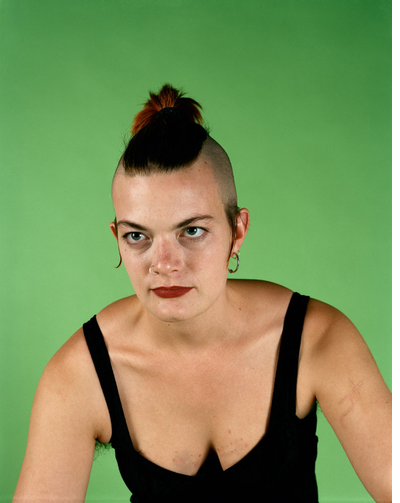
With a distinctly empathetic gaze, Catherine Opie’s Portraits series (1993–7) captures the vibrancy and humanity of her Queer community. Inspired by sixteenth-century painter Hans Holbein the Younger, Opie constructs a royal family of her friends to challenge normative views of gender and sexuality. Sitters are depicted frontally against a solid background. For Opie, the visual language of courtly portraiture offers a rhetoric of liberation: “There was an equality to [Holbein’s] paintings—they weren’t demigod portraits, they were just incredibly detailed and real.” It is testament to Opie’s eye for nuance and the trust she builds with her sitters that she brings out such psychological complexity. Opie's photography redefines portraiture, probing the complex questions of who we are, how we present ourselves and why representation matters. Portraiture has always been about “being seen”—and a collaboration between sitter and portraitist to this end—but Opie has re-evaluated it as inclusive, intimate and reciprocal.
“Chloe” (1993) is reproduced from Catherine Opie: To Be Seen, published to accompany the eponymous exhibition on view at the National Portrait Gallery, London, through May 31, 2026. The publication features more than 100 color images and a tactile quarter-bound cover, designed in close consultation with the artist. continue to blog
FORMAT: Hbk, 9 x 11.25 in. / 192 pgs / 103 color / 21 b&w. LIST PRICE: U.S. $49.95 LIST PRICE: CANADA $69.95 ISBN: 9781855148307 PUBLISHER: National Portrait Gallery AVAILABLE: 4/21/2026 DISTRIBUTION: D.A.P. RETAILER DISC: TRADE PUBLISHING STATUS: Active AVAILABILITY: In stock TERRITORY: NA ONLY
Published by National Portrait Gallery. Edited by Catherine Opie, Clare Freestone. Text by Joan Didion, Clare Freestone, Magdalene Keaney, Mark Godfrey, Alistair O'Neil.
Thirty-plus years of Opie's stylized investigations of identity and social belonging through portraiture
This publication accompanies a major survey at the National Portrait Gallery, spanning the entirety of American photographer Catherine Opie's career. At the core of Opie's work is a persistent exploration of society's evolving ideas regarding community, identity and belonging, especially within the LGBTQ+ community. Opie's wide-ranging portraits include intimate studio shots of friends and figures, capturing moments of vulnerability, pride and resilience. Alongside these, she creates socially engaged documentary narratives, such as her images from the inauguration of Barack Obama. These photographs work in dialogue with one another to create new narratives, challenging viewers to reflect on the figures most commonly portrayed in art and those who go unseen.
Featuring a tactile quarter-bound cover, To Be Seen was created in close collaboration with the artist and offers an illuminating overview of the artist's lifelong interrogation of social and artistic representation. The volume includes high-quality reproductions of photographs produced throughout her career, encompassing her meticulously crafted studio portraits as well as her context-specific shots captured across America. Supplementing these images is a suite of texts, featuring scholarly essays, an excerpt from Joan Didion's "On the Road" and a dialogue between Opie and exhibition designer Katy Barkan.
Living and working in Los Angeles, Catherine Opie (born 1961) relays between conceptual and documentary approaches to image-making. Best known for her highly stylized color portraits, Opie's work explores social strata throughout America, from Black football players in the Midwest to leather-clad S&M practitioners. Her work has enjoyed immense critical acclaim, including retrospectives at the Guggenheim Museum in New York in 2008 and the Institute of Contemporary Art, Boston in 2011.