Museum Exhibition Catalogues, Monographs, Artist's Projects, Curatorial Writings and Essays
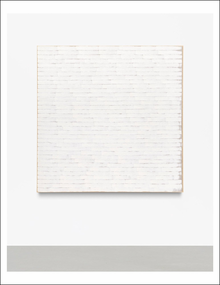
"From the outset, he indicated his preference for white paints and square formats. White, in optics, is not a color as such, but a manifestation of all colors enabled by light. Neutral, soft, inherently accumulative, white offers Ryman the possibility of unifying his surface as a whole, covering layers of other paints but also revealing white's nuances. The shape of the square, like white, is also neutral. With no references to the recognizable environment and free of any associations, it is a perfectly balanced, geometric structure on equal sides. Both the square and the white enabled Ryman to realize his paintings not in the traditional sense of picture or image but as objects in space." Vesela Sretenovic, excerpted from Robert Ryman: Variations and Improvisations.
Edited with text by Matt Connors, Wells-Fray Smith. Foreword by Shanay Jhaveri. Introduction by Wells-Fray Smith. Text by Darby English, Erica Cooke, Peter Osborne, Caleb Azumah Nelson, Adam Caruso, Matt Connors, Fergus Feehily, Roni Horn, Soweto Kinch, Adam Pendleton, Howardena Pindell, Robert Ryman, Richard Tuttle.
A vital resource for understanding the depth and significance of Ryman’s practice, this volume reveals his steadfast belief that painting, when really seen, is for pleasure
Pbk, 8 x 11 in. / 420 pgs / 100 color / 100 bw. | 11/3/2026 | Awaiting stock $75.00
Published by Pre-Echo Press. Edited with text by Matt Connors, Wells-Fray Smith. Foreword by Shanay Jhaveri. Introduction by Wells-Fray Smith. Text by Darby English, Erica Cooke, Peter Osborne, Caleb Azumah Nelson, Adam Caruso, Matt Connors, Fergus Feehily, Roni Horn, Soweto Kinch, Adam Pendleton, Howardena Pindell, Robert Ryman, Richard Tuttle.
American artist Robert Ryman believed that the poetry of painting was in feeling. For almost 60 years, he devoted himself to making paintings devoid of pictures of symbolic content, instead focusing his attention on materials and their effects. In works that range from intimate to monumental and flat to three-dimensional, Ryman explored the basic assumptions of painting—that it involves paint, on a surface, hung on a wall. His rigorous and playful body of work is marked equally by surprise and subtlety, sameness and difference, and by shifting uses of paint, gesture, support, size, line, fastenings to the wall and space. This new publication designed by Studio Mathias Clottu documents a range of Ryman’s paintings, showing the variety he produced as he experimented with painting’s expanse. Alongside new scholarship from influential writers, artists and musicians including Darby English, Roni Horn, Richard Tuttle and Howardena Pindell, this book includes never-before-seen archival material and pays special attention to Ryman’s studio. Born in Nashville, Robert Ryman (1930–2019) moved to New York with the hopes of becoming a professional saxophonist. To make ends meet, he took a job as a security guard at the Museum of Modern Art, New York, but became fascinated with the Abstract Expressionist works on display there. He started painting in the early 1950s, and was honored with a retrospective exhibition at MoMA in 1993, almost 40 years later.
Published by Actes Sud/Collection Lambert. Text by Stéphane Ibars. Interview by Yvon Lambert.
The second volume of the Lambert Collection Icons series collects some of the finest works by one of America’s foremost abstract painters, and narrates the creation of his paintings from compositional elements to their “activation” in exhibition spaces.
Robert Ryman (1930-2019) was a giant of minimalist painting. He settled in New York in 1952, initially aspiring to a career as a jazz musician. Alone he discovered art, visiting the city’s myriad museums and galleries, and taught himself to paint. In a career spanning 60 years, Ryman relentlessly pared down the essentials of painting and its emotional possibilities.
Published by The Phillips Collection. Text by Vesela Sretenovic.
For over 50 years, Robert Ryman (born 1930) has explored the materiality of paint and the surfaces to which he applies it, in white-on-white paintings that subtly attain the status of painted objects rather than patterned gestures or depictions of further objects. Published on the occasion of the Phillips Collection's Ryman exhibition in Washington, D.C., Robert Ryman: Variations and Improvisations presents approximately 25 small-scale works, all of which are drawn from private collections, and some of which have only rarely been shown in the U.S. An interview with the artist is included.
PUBLISHER The Phillips Collection
BOOK FORMAT Paperback, 7.5 x 7.5 in. / 32 pgs / 21 color.
PUBLISHING STATUS Pub Date 8/30/2010 Out of print
DISTRIBUTION D.A.P. Exclusive Catalog: FALL 2010 p. 95
PRODUCT DETAILS ISBN 9780943044354TRADE List Price: $15.95 CAD $17.50
Published by Ridinghouse. Edited by Vittorio Colaizzi.
Through an extremely restricted vocabulary, Robert Ryman became a leading figure on the fringes of Minimalist and Conceptual art. This anthology of essays reviews and charts the evolution of the artist’s critical reception. A comprehensive selection of over 60 essays and exhibition reviews has been collated into one volume, including texts by some of the most influential art historians and critics.
The writings look at Ryman’s work within the context of the 'challenge to painting' in the 1960s, as well as the artist's work in relation to other influential painters in art history.
Drawing upon the words of key contemporary thinkers, an introduction by Vittorio Colaizzi explores the importance of elements of ‘support, colour, brushstroke’ in Ryman's paintings.
Published by Walther König/Raussmuller Collection. Edited by Christel Sauer. Text by Urs Raussmüller, Meret Arnold.
On July 27, 2006, the important American Minimalist painter, Robert Ryman, and curator Urs Raussmüller conducted a public conversation in Edinburgh, discussing in detail the qualities that define Ryman's works and distinguish them from other paintings. The conversations took place in the garden next to Inverleith House--the eighteenth-century estate that now houses an innovative program of temporary exhibitions run by the Royal Botanic Garden--and touched on issues that rarely surface in the discourse on painting, from the feelings that a painting can engender to what the viewers can gain from the contemplation of an artwork. With generous photo documentation of Ryman's exhibition at Inverleith House, as well as the garden talk and other unguarded moments, this book-length conversation is essential fare for all fans of Ryman's work and working philosophy.
Published by Peter Blum Edition, New York. Essay by Peter Blum.
The works in this exhibition catalogue record the time when Robert Ryman, then in his early twenties, was formulating his disciplined approach to painting. On off-white and translucent materials including wallpaper, a circular coffee filter, newsprint and mylar, Ryman drew, tooled, brushed and pressed his marks using a flat table to support the work. His decision to use the square as a consistent format for non-narrative work was set, and while he sporadically used color in these earliest works, he subsequently chose white almost exclusively in the process of eliminating all that was superfluous to a painting.
PUBLISHER
BOOK FORMAT Hardcover, 8 x 10.5 in. / 72 pgs / 31 color / 3 bw.
PUBLISHING STATUS Pub Date 6/15/2004 Out of print
DISTRIBUTION D.A.P. Exclusive Catalog: SPRING 2005 p. 147
PRODUCT DETAILS ISBN 9780935875225TRADE List Price: $85.00 CAD $112.50 GBP £75.00
 Robert Ryman
 Robert Ryman: Variations and Improvisations
 Robert Ryman: Critical Texts
 Robert Ryman: At Inverleith House, Royal Botanic Garden, Edinburgh
 Robert Ryman: Works On Paper 1957-1964