| |||||||||||||||||||||||||
ARTIST MONOGRAPHS
|
|

STATUS: Out of stock indefinitely. |
 A.R. Penck: Rites de Passage
Published by Walther König, Köln.
Introduction by Olivier Kaeppelin. Foreword by Adrien Maeght. Text by Danièle Cohn, Ulf Jensen. Interview by Eddy Devolder, Wilfried Dickhoff.
PUBLISHER
Walther König, Köln
BOOK FORMAT
Flexi, 9.75 x 12 in. / 500 pgs / 168 color / 70 bw.
PUBLISHING STATUS
Pub Date 9/26/2017
Out of print
DISTRIBUTION
D.A.P. Exclusive
Catalog: SPRING 2018 p. 201
PRODUCT DETAILS
ISBN 9783960981107 FLAT40
List Price: $65.00 CAD $87.00
AVAILABILITY
Not available
STATUS: Out of print | 00/00/00 For assistance locating a copy, please see our list of recommended out of print specialists |
 A.R. Penck: Felt Works and Drawings 1972-1995
Published by Walther König, Köln.
Text by Eric Darragon.
PUBLISHER
Walther König, Köln
BOOK FORMAT
Hardcover, 10.75 x 12 in. / 104 pgs / 54 color.
PUBLISHING STATUS
Pub Date 6/30/2011
Out of print
DISTRIBUTION
D.A.P. Exclusive
Catalog: FALL 2011 p. 150
PRODUCT DETAILS
ISBN 9783865609281 TRADE
List Price: $47.50 CAD $65.00
AVAILABILITY
Not available
STATUS: Out of print | 00/00/00 For assistance locating a copy, please see our list of recommended out of print specialists |
 A.R. Penck
Published by Mitchell-Innes & Nash.
Text by Siegfried Gohr.
PUBLISHER
Mitchell-Innes & Nash
BOOK FORMAT
Paperback, 11.75 x 9 in. / 48 pgs / 13 color / 14 bw.
PUBLISHING STATUS
Pub Date 3/1/2007
Out of print
DISTRIBUTION
D.A.P. Exclusive
Catalog: SPRING 2007 p. 138
PRODUCT DETAILS
ISBN 9780974960753 TRADE
List Price: $35.00 CAD $40.00
AVAILABILITY
Not available
STATUS: Out of print | 00/00/00 For assistance locating a copy, please see our list of recommended out of print specialists |
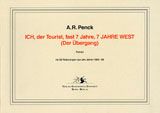
PUBLISHER
GACHNANG & SPRINGER
BOOK FORMAT
Hardcover, 11.5 x 9 / 132 pgs / 64 bw
PUBLISHING STATUS
Pub Date 1/2/1991
No longer our product
DISTRIBUTION
D.A.P. Exclusive
Catalog: SPRING 1991
PRODUCT DETAILS
ISBN 9783906127262 TRADE
List Price: $95.00 CAD $115.00
AVAILABILITY
Not available

PUBLISHER
Gachnang & Springer
BOOK FORMAT
Hardcover, 9 x 12.5 / pgs / 49 color / 286 bw.
PUBLISHING STATUS
Pub Date 1/2/1986
No longer our product
DISTRIBUTION
D.A.P. Exclusive
Catalog: UNKNOWN 1990
PRODUCT DETAILS
ISBN 9783906127095 TRADE
List Price: $175.00 CAD $210.00
AVAILABILITY