Edited with text by Glaucea Helena de Britto, Isabella Rjeille. Text by Carolina Caycedo, Daiane Höhn, Esther Vital, Louise Löbler, Monise Busquets, Roberta Bacic.
Vernacular textiles as rallying call: 47 arpilleras from Brazilian women that advocate for collective construction of state infrastructure
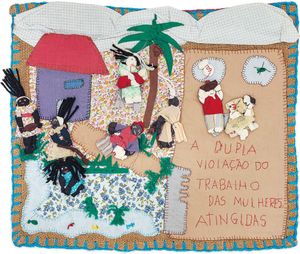
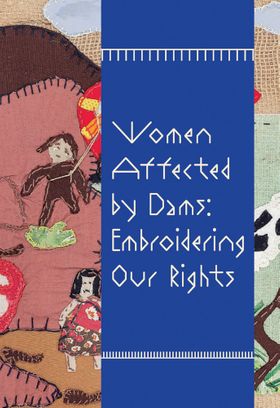
Arpilleras, colorful patchwork pieces made of scraps of fabric embroidered on jute, originated in Chile in the 1960s as an expression of female protagonism during the dictatorship of Augusto Pinochet. In subsequent years, the vernacular art form has spread across the globe, inspiring activist groups such as the National Women's Collective of the Movimento dos Atingidos por Barragens (Movement of People Affected by Dams, or MAB), a Brazilian movement that emerged in the 1980s to demand a popular energy project. Embroidering Our Rights gathers 47 arpilleras created between 2013 and 2024 by women in workshops organized by MAB throughout Brazil. The artists' textiles address issues of domestic violence; disconnection between land and community; water and electricity access; the impact of dams and river pollution on fishing and family livelihoods; and other human and environmental rights violations.
Featured image is reproduced from 'Women Affected by Dams: Embroidering Our Rights.'
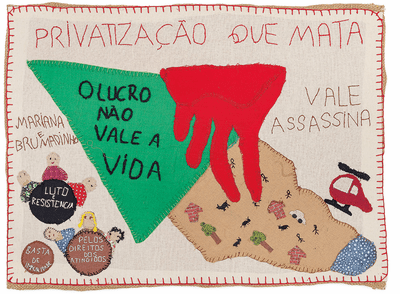
Created by a consortium of Brazilian women united under the Coletivo Nacional de Mulheres do Movimento dos Atingidos por Barragens (MAB) umbrella, arpilleras—Spanish for burlap, or scraps of fabric embroidered on jute—became a language of female agency during the Pinochet regime. Primarily created by mothers, wives and relatives of political prisoners, these works depict scenes of everyday life, repression and the struggle for rights. This 2019 arpillera, titled Privatização que mata [Privatization That Kills] and produced by women from the state of Pará, depicts a scene of chaos. A large green triangle dominates half the composition, an oblique reference to the Brazilian mining company Vale, infamous for two catastrophic dam failures: Mariana, in 2015, and Brumadinho, in 2019. Embroidered on top of the logo is the MAB slogan “O lucro não vale a vida [Profit is not worth life].” Blood drips off of the logo, down to the earth below, where a post-traumatic maelstrom plays out in the mud. A helicopter hovers above, searching for missing bodies among the scene of devastation. Groups of protestors surround the appliqué, holding placards featuring messages such as “LUTO e RESISTENCIA” to express their outrage and demands for justice. “For many people, the arpillera may seem like just a piece of art to hang on the wall. For us, the political significance of this textile testimony lies in the organization of women, in the fight for their rights and in the political proposition—of dreams, of utopias, of what we long for. It’s a denunciation, but it’s also a project of hope,” writes Daiane Höhn, a MAB activist. continue to blog
FORMAT: Hbk, 6.5 x 9.5 in. / 264 pgs / 89 color. LIST PRICE: U.S. $35.00 LIST PRICE: CANADA $49 GBP £30.00 ISBN: 9786557770818 PUBLISHER: Museu de Arte de São Paulo Assis Chateaubriand/KMEC Books AVAILABLE: 3/10/2026 DISTRIBUTION: D.A.P. RETAILER DISC: TRADE PUBLISHING STATUS: Active AVAILABILITY: In stock TERRITORY: WORLD Except Brazil
Published by Museu de Arte de São Paulo Assis Chateaubriand/KMEC Books. Edited with text by Glaucea Helena de Britto, Isabella Rjeille. Text by Carolina Caycedo, Daiane Höhn, Esther Vital, Louise Löbler, Monise Busquets, Roberta Bacic.
Vernacular textiles as rallying call: 47 arpilleras from Brazilian women that advocate for collective construction of state infrastructure
Arpilleras, colorful patchwork pieces made of scraps of fabric embroidered on jute, originated in Chile in the 1960s as an expression of female protagonism during the dictatorship of Augusto Pinochet. In subsequent years, the vernacular art form has spread across the globe, inspiring activist groups such as the National Women's Collective of the Movimento dos Atingidos por Barragens (Movement of People Affected by Dams, or MAB), a Brazilian movement that emerged in the 1980s to demand a popular energy project.
Embroidering Our Rights gathers 47 arpilleras created between 2013 and 2024 by women in workshops organized by MAB throughout Brazil. The artists' textiles address issues of domestic violence; disconnection between land and community; water and electricity access; the impact of dams and river pollution on fishing and family livelihoods; and other human and environmental rights violations.