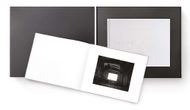
Over a decade in the making, Sugimoto's masterpiece observatory building at his art foundation in Odawara, Japan, is the culmination of his architectural practice
Apart from photography, Japanese artist Hiroshi Sugimoto has been working in sculpture, performing arts and architecture for more than 20 years. Since the early 2010s, he has been constructing the Enoura Observatory, and with his singular vision he has brought together ancient and contemporary Japanese traditions in one art and architectural complex. This book provides an account of this stunning multidisciplinary project. The Observatory, part of the artist's Odawara Art Foundation, is sited on a hilly area covered with citrus trees in Odawara, nestled against the outer rim of the Hakone Mountains and overlooking Sagami Bay. Odawara is home to groups of artisans with mastery of sophisticated techniques that have been handed down for centuries. Sugimoto has constructed the Enoura Observatory using these techniques, which are growing increasingly difficult to preserve. He envisions it as a forum for disseminating art and culture both within Japan and to the rest of the world. The stunning photographs in Enoura Observatory: Land of Distant Memories reveal Sugimoto's poetic vision for this total work of art that is the culmination of his art practice. Hiroshi Sugimoto was born in Tokyo in 1948. A photographer since the 1970s, his work deals with history and temporal existence by investigating themes of time, empiricism and metaphysics. Sugimoto has received numerous grants and fellowships, and his work is held in the collections of Tate Gallery, London, the Museum of Contemporary Art, Chicago, and the Metropolitan Museum of Art, among many others. Sugimoto lives between Tokyo and New York City.
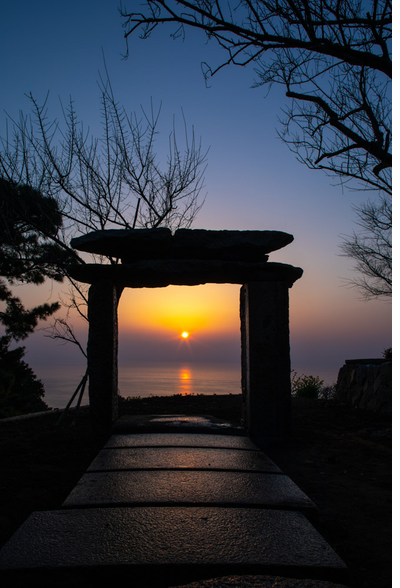
Hiroshi Sugimoto is known throughout the world for his mastery in photography and architecture. But fewer people know that he has long been a collector (and once a dealer) of Japanese antiquities, in addition to practicing as a sculptor and maker in the performing arts. In 2009, he purchased a twelve acre citrus grove overlooking Sagami Bay on the coast of Odawara, Japan, and thereafter began the meticulous design and planning of his terrestrial celestial masterpiece, Enoura Observatory. In this new book designed by Takaaki Matsumoto, Sugimoto documents his journey, in context of his life as an artist, in a remarkably personal, genuine and subtly humorous style that is a pleasure to read. Pictured here, the rising sun seen through the stone torii gate of the Uchōten Tea House. Sugimoto had it built to greet the spring equinox. continue to blog
Hiroshi Sugimoto: Enoura Observatory Land of Distant Memory
Published by MW Editions. Text by Hiroshi Sugimoto.
Over a decade in the making, Sugimoto's masterpiece observatory building at his art foundation in Odawara, Japan, is the culmination of his architectural practice
Apart from photography, Japanese artist Hiroshi Sugimoto has been working in sculpture, performing arts and architecture for more than 20 years. Since the early 2010s, he has been constructing the Enoura Observatory, and with his singular vision he has brought together ancient and contemporary Japanese traditions in one art and architectural complex. This book provides an account of this stunning multidisciplinary project.
The Observatory, part of the artist's Odawara Art Foundation, is sited on a hilly area covered with citrus trees in Odawara, nestled against the outer rim of the Hakone Mountains and overlooking Sagami Bay. Odawara is home to groups of artisans with mastery of sophisticated techniques that have been handed down for centuries. Sugimoto has constructed the Enoura Observatory using these techniques, which are growing increasingly difficult to preserve. He envisions it as a forum for disseminating art and culture both within Japan and to the rest of the world. The stunning photographs in Enoura Observatory: Land of Distant Memories reveal Sugimoto's poetic vision for this total work of art that is the culmination of his art practice.
Hiroshi Sugimoto was born in Tokyo in 1948. A photographer since the 1970s, his work deals with history and temporal existence by investigating themes of time, empiricism and metaphysics. Sugimoto has received numerous grants and fellowships, and his work is held in the collections of Tate Gallery, London, the Museum of Contemporary Art, Chicago, and the Metropolitan Museum of Art, among many others. Sugimoto lives between Tokyo and New York City.