"One cannot create happiness with beautiful objects, but one can spoil quite a lot of happiness with bad ones." —Finn Juhl
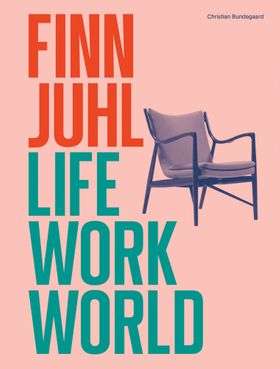
"Art is art, and a chair is a chair"—for the architect and furniture designer Finn Juhl, there were no gray areas. Yet Juhl's designs often strike a delicate balance between the fine and applied arts. As one of the leading figures in the "golden age" of Danish furniture design—amplified by his commissions and collaborations in the United States—Juhl was instrumental in drawing attention to the aesthetics and craftsmanship of the Danish chair. Life, Work, World tells Finn Juhl's story from the breakthrough of modernism around 1930 through the heights of cabinet-maker's furniture in the 1940s and 1950s, and up to the reemergence of his near-forgotten masterpieces in the 1990s, their sublime execution admired afresh. Originally published by Strandberg in 2018 then reissued by Phaidon the following year, this expanded edition includes more pages and over 400 illustrations. The new "Selected Presentations" section spotlights Juhl's most iconic designs, including his Chieftain Chair and Baker Sofa. Finn Juhl (1912–89) studied architecture under Kay Fisker at the Royal Danish Academy of Fine Arts. After working for Vilhelm Lauritzen's firm for 10 years, he established his own studio in 1945. In 1951 he was featured in the Good Design exhibition in Chicago, and completed the Trusteeship Council Chamber at the Headquarters of the United Nations in New York.
Featured image is reproduced from 'Finn Juhl: Life, Work, World.
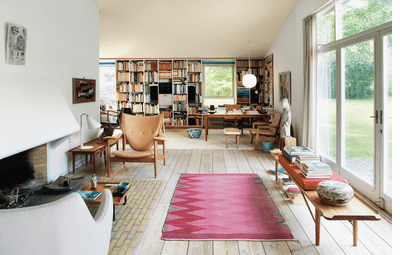
Never will we tire of looking at the interior of Danish architect and designer Finn Juhl’s midcentury home and workspace. Reproduced from new release Finn Juhl: Life, Work, World, this photograph captures the balance of scale, light, texture, color and all-around stimulation and experimentation that we have come to love in this leading figure in the “golden age” of Danish furniture design. It is among 420 stunning reproductions, including archival materials, new and documentary photographs, architectural plans and renderings, and of course Juhl’s inimitable watercolors. “The modern endeavor is … an attempt to combine a moral idea about honesty, sincerity and naked function with [a] new apprehension of space, made possible by new means of construction and developed in step with new habits and structures of daily life,” Christian Bundegaard writes. “It is perhaps typical of Juhl’s sensibility and sense of synthesis that he describes this new apprehension of space as though it were a release, an almost artistic experience in which we ourselves inhabit the work of art. Space is no longer an ‘easily comprehensible volume of air but becomes moveable, dynamic … People’s free bodily movements, not following a geometric formula, appear to be symbolized by this free space, as are their imaginings and ideas.’” continue to blog
FORMAT: Hbk, 8.5 x 11.5 in. / 272 pgs / 120 color / 300 b&w. LIST PRICE: U.S. $55.00 LIST PRICE: CANADA $77 ISBN: 9788794418676 PUBLISHER: Strandberg Publishing AVAILABLE: 8/26/2025 DISTRIBUTION: D.A.P. RETAILER DISC: TRADE PUBLISHING STATUS: Active AVAILABILITY: In stock TERRITORY: NA ONLY
Published by Strandberg Publishing. Text by Christian Bundegaard.
"One cannot create happiness with beautiful objects, but one can spoil quite a lot of happiness with bad ones." —Finn Juhl
"Art is art, and a chair is a chair"—for the architect and furniture designer Finn Juhl, there were no gray areas. Yet Juhl's designs often strike a delicate balance between the fine and applied arts. As one of the leading figures in the "golden age" of Danish furniture design—amplified by his commissions and collaborations in the United States—Juhl was instrumental in drawing attention to the aesthetics and craftsmanship of the Danish chair.
Life, Work, World tells Finn Juhl's story from the breakthrough of modernism around 1930 through the heights of cabinet-maker's furniture in the 1940s and 1950s, and up to the reemergence of his near-forgotten masterpieces in the 1990s, their sublime execution admired afresh. Originally published by Strandberg in 2018 then reissued by Phaidon the following year, this expanded edition includes more pages and over 400 illustrations. The new "Selected Presentations" section spotlights Juhl's most iconic designs, including his Chieftain Chair and Baker Sofa.
Finn Juhl (1912–89) studied architecture under Kay Fisker at the Royal Danish Academy of Fine Arts. After working for Vilhelm Lauritzen's firm for 10 years, he established his own studio in 1945. In 1951 he was featured in the Good Design exhibition in Chicago, and completed the Trusteeship Council Chamber at the Headquarters of the United Nations in New York.