Edited by Lærke Rydal Jørgensen, Kirsten Degel. Foreword by Poul Erik Tøjner, Kirsten Degel. Introduction by Cathleen Chaffee. Text by Nicole Rudick, David J. Getsy, Delia Solomons.
A sweeping retrospective for radical Pop artist Marisol, an enigmatic and overlooked figure of the 1960s
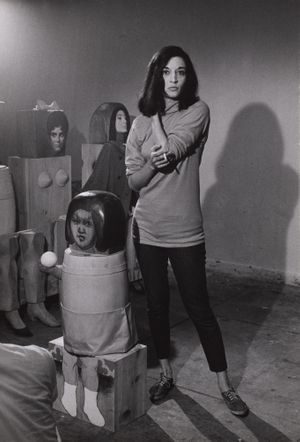
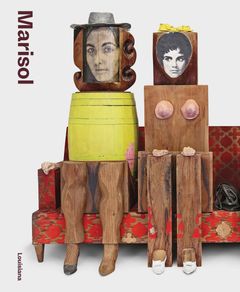
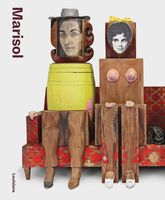
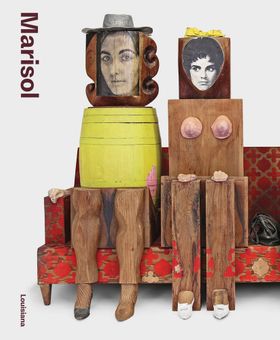
Marisol (1930–2016) was one of the most radical and visionary artists of her generation. Combining found objects, plaster casts of her own body, and a singular blend of Pop and folk art, she created large tableaux that were by turns unsettling and humorous, colorful and dark. Her works posed sharp existential questions and made powerful statements on entrenched gender roles and equality. A close friend of Andy Warhol and a fixture in his early experimental films, Marisol enjoyed critical acclaim in the United States during the 1960s. In the following decade, she turned away from Pop toward more overtly political art, challenging the public and critics alike. Undeterred by changing tastes, she pursued an uncompromising practice across sculpture, drawing, printmaking and photography. This book accompanies the first major European presentation of Marisol's work, reclaiming her position as a forgotten classic through a swath of pieces spanning her career. Essays explore her place among female Pop artists, the gendered readings of her sculptures and the remarkable breadth of her creative vision.
Venezuelan-American sculptor Marisol was well known among the early-1960s Pop artists before turning from the limelight in the late 1960s, when she began to experiment with political and environmental themes. In 1968, she participated in the Venice Biennale and then Documenta, where she was one of just four women among the 149 exhibiting artists. “Despite her success, she grew frustrated with the brutal police response to Vietnam War protests in the United States and spent much of the second half of 1968 traveling in India, Nepal, Cambodia, Sri Lanka and Thailand,” Cathleen Chaffee writes in the new Louisiana Museum of Modern Art exhibition catalog. “In 1969, she intensively trained to scuba dive in Tahiti. In new works made after these experiences, she explored human-animal interdependence as well as connections between the American military-industrial complex and the life of the oceans. These sculptures include her chimeralike The Fishman (1973, shown here) and sculptures of barracuda and needlefish, which she connected to missiles and other modern forms of weaponry. As she later told an interviewer, ‘I have always had a special communication with the world of animals. I wish humans were like that.’ In seeking to understand the life of underwater creatures through her remarkable sculptures, Marisol combined aspects of the evolutionary mimicry so common in the animal kingdom with a deeply sympathetic human approach. One of the most direct ways to understand another is to try to see from their perspective and feel what it is like to be them: to ‘walk in their shoes,’ swim in their water. In casts she appended to these deeply strange aquatic sculptures, Marisol studiously puckered and contorted her face to appear like the fish with which she was absorbed.” continue to blog
FORMAT: Hbk, 8.5 x 10.25 in. / 128 pgs / 140 color / 20 b&w. LIST PRICE: U.S. $35.00 LIST PRICE: CANADA $49 GBP £30.00 ISBN: 9788793659926 PUBLISHER: Louisiana Museum of Modern Art AVAILABLE: 3/10/2026 DISTRIBUTION: D.A.P. RETAILER DISC: TRADE PUBLISHING STATUS: Active AVAILABILITY: In stock TERRITORY: WORLD
Published by Louisiana Museum of Modern Art. Edited by Lærke Rydal Jørgensen, Kirsten Degel. Foreword by Poul Erik Tøjner, Kirsten Degel. Introduction by Cathleen Chaffee. Text by Nicole Rudick, David J. Getsy, Delia Solomons.
A sweeping retrospective for radical Pop artist Marisol, an enigmatic and overlooked figure of the 1960s
Marisol (1930–2016) was one of the most radical and visionary artists of her generation. Combining found objects, plaster casts of her own body, and a singular blend of Pop and folk art, she created large tableaux that were by turns unsettling and humorous, colorful and dark. Her works posed sharp existential questions and made powerful statements on entrenched gender roles and equality. A close friend of Andy Warhol and a fixture in his early experimental films, Marisol enjoyed critical acclaim in the United States during the 1960s. In the following decade, she turned away from Pop toward more overtly political art, challenging the public and critics alike. Undeterred by changing tastes, she pursued an uncompromising practice across sculpture, drawing, printmaking and photography.
This book accompanies the first major European presentation of Marisol's work, reclaiming her position as a forgotten classic through a swath of pieces spanning her career. Essays explore her place among female Pop artists, the gendered readings of her sculptures and the remarkable breadth of her creative vision.