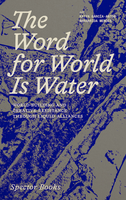
Edited by Eva Franch i Gilabert, Mireia Luzárraga, Alejandro Muiño.
An essential resource for architects, activists, policymakers and anyone passionate about eco-social transformation
Drawing on the United Nations' assertion that "the climate crisis is mainly a water crisis," this thought-provoking book compiles over 100 key terms defined by contemporary thinkers in science, philosophy, politics, activism and architecture. These terms—such as Water Rights, Hydrocatharsis, Decommodification of Water and Liquid Modernity—form a vital lexicon to guide transformative action and foster a more symbiotic relationship with water. Structured as a collaborative exploration, the book combines scientific insight, philosophical depth and architectural vision to redefine how we engage with water socially, politically and ecologically. Illustrated with cartographic case studies, the volume offers vivid and hopeful scenarios for reshaping human–water interdependence. Through its diverse contributors and an interdisciplinary approach, 100 Words for Water challenges readers to rethink water management and design as the foundation of a resilient, multispecies future.
STATUS: Out of stock
Temporarily out of stock pending additional inventory.
FORMAT: Pbk, 6.5 x 9.5 in. / 316 pgs / 127 color. LIST PRICE: U.S. $28.00 LIST PRICE: CANADA $39 ISBN: 9783037787915 PUBLISHER: Lars Müller Publishers AVAILABLE: 10/28/2025 DISTRIBUTION: D.A.P. RETAILER DISC: TRADE PUBLISHING STATUS: Active AVAILABILITY: Out of stock TERRITORY: NA LA
100 Words for Water A Projective Ecosocial Vocabulary
Published by Lars Müller Publishers. Edited by Eva Franch i Gilabert, Mireia Luzárraga, Alejandro Muiño.
An essential resource for architects, activists, policymakers and anyone passionate about eco-social transformation
Drawing on the United Nations' assertion that "the climate crisis is mainly a water crisis," this thought-provoking book compiles over 100 key terms defined by contemporary thinkers in science, philosophy, politics, activism and architecture. These terms—such as Water Rights, Hydrocatharsis, Decommodification of Water and Liquid Modernity—form a vital lexicon to guide transformative action and foster a more symbiotic relationship with water. Structured as a collaborative exploration, the book combines scientific insight, philosophical depth and architectural vision to redefine how we engage with water socially, politically and ecologically. Illustrated with cartographic case studies, the volume offers vivid and hopeful scenarios for reshaping human–water interdependence. Through its diverse contributors and an interdisciplinary approach, 100 Words for Water challenges readers to rethink water management and design as the foundation of a resilient, multispecies future.