Edited by Fernando Gallegos, Duen Neka'hen Sacchi. Text by Roberto Tondopó.
Set within the contexts of colonial history and religious syncretism, Tránsito is a lush study on transformation and resistance
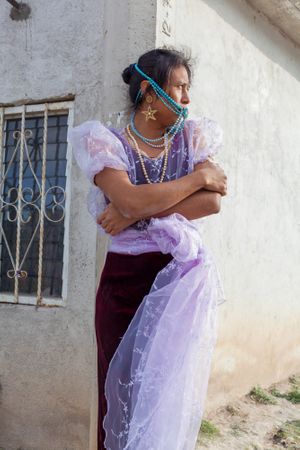
Mexican photographer Roberto Tondopó's (born 1978) Tránsito is a photographic exploration of grief, ritual and identity. This photobook connects the death of Tondopó's father, Tránsito, with the artist's participation in the Chuntá, a local festival where men dress as women in honor of Saint Sebastian. By becoming a Chuntá, Tondopó pays tribute to his father and reflects on how mourning can prompt personal and cultural transformation. The Fiesta Grande embodies both tradition and contradiction: a deeply conservative community embracing a public ritual of gender fluidity. This tension serves as a point of departure for the project's broader interrogation of identity, focusing on the instability of fixed categories such as masculinity, sexuality and national heritage. The book's special features include a Japanese top-folded interior as well as a tipped-in sticker. 208 pages, Japanese fold. Cover with tipped on photo in three variants.
FORMAT: Pbk, 7.5 x 10 in. / 208 pgs / 63 color / 63 duotone. LIST PRICE: U.S. $60.00 LIST PRICE: CANADA $84 GBP £50.00 ISBN: 9781734656268 PUBLISHER: Capricious Publishing AVAILABLE: 6/30/2026 DISTRIBUTION: D.A.P. RETAILER DISC: TRADE PUBLISHING STATUS: Active AVAILABILITY: In stock TERRITORY: WORLD
Published by Capricious Publishing. Edited by Fernando Gallegos, Duen Neka'hen Sacchi. Text by Roberto Tondopó.
Set within the contexts of colonial history and religious syncretism, Tránsito is a lush study on transformation and resistance
Mexican photographer Roberto Tondopó's (born 1978) Tránsito is a photographic exploration of grief, ritual and identity. This photobook connects the death of Tondopó's father, Tránsito, with the artist's participation in the Chuntá, a local festival where men dress as women in honor of Saint Sebastian. By becoming a Chuntá, Tondopó pays tribute to his father and reflects on how mourning can prompt personal and cultural transformation. The Fiesta Grande embodies both tradition and contradiction: a deeply conservative community embracing a public ritual of gender fluidity. This tension serves as a point of departure for the project's broader interrogation of identity, focusing on the instability of fixed categories such as masculinity, sexuality and national heritage. The book's special features include a Japanese top-folded interior as well as a tipped-in sticker. 208 pages, Japanese fold. Cover with tipped on photo in three variants.