Edited with text by Anne Umland. Text by Mia Matthias, Samantha Small.
Inside Brancusi’s Paris atelier where he worked for 40 years, as seen through the artist’s own extraordinary photographs
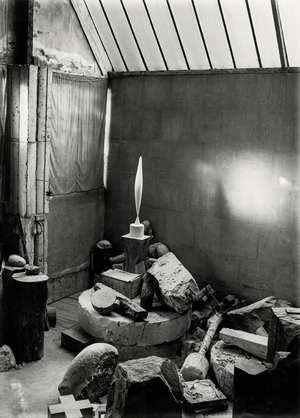
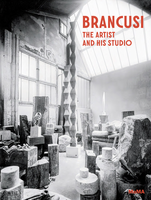
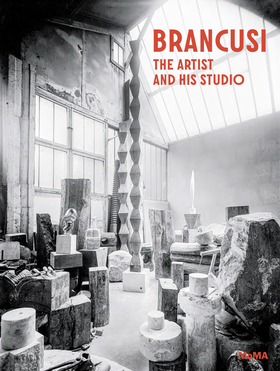
Dissatisfied with how others represented his work, the legendary sculptor Constantin Brancusi (1876–1957) took up the camera himself. Over his lifetime, he produced more than 1,000 photographs documenting the evolution of his artworks and the unique setting in which they were made. These luminous tritone images capture his ever-changing studio over the course of four decades, ranging from intimate studies of individual sculptures to wide-angle views of carefully arranged ensembles. Layered scenes of in-progress artworks, tools and raw materials—including salvaged oak beams and rough blocks of marble—offer behind-the-scenes glimpses of Brancusi’s creative process. Photographs of the artist alongside an array of visitors, including Man Ray, Berenice Abbott, Marcel Duchamp and Mina Loy, illustrate the studio as a lively space of work, play and display. Brancusi’s photographs bring to life his art and his studio as he wanted them to be seen, with extraordinary vividness and intimacy. Featuring more than 130 photographs taken by the artist, this lavishly illustrated volume offers a revealing portrait of Brancusi’s dynamic environment that ultimately became a work of art in its own right.
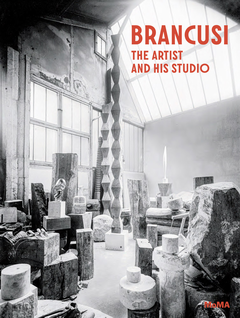
View of the studio: "Column of the Kiss" (1916–17), "Bird in Space" (1923, white marble). "Before December" 1923. From 'Brancusi: The Artist and His Studio,' published by The Museum of Modern Art, New York.
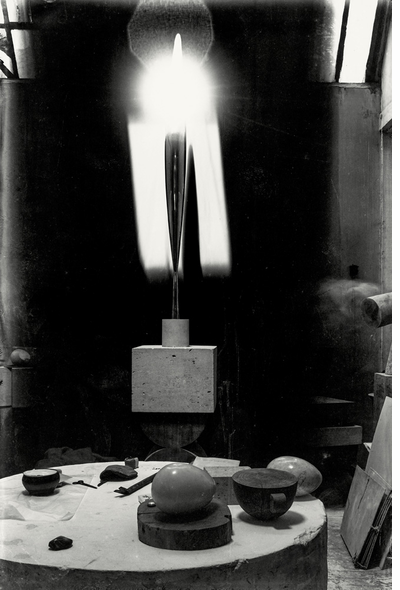
“’Why write?’ Constantin Brancusi asked the author Robert Payne in 1949. ‘Why not just show the photographs?’ The photographs Brancusi had in mind were his own. By the time of his conversation with Payne, the seventy-three-year-old artist had long been dissatisfied with the efforts not only of writers but also of other photographers to represent or interpret his sculptures. This dissatisfaction had led him, decades earlier, to become the exclusive photographer of his own work and his late-life remark to Payne underscores his fierce protectiveness over how his sculpture met the public eye and on whose terms. Although Brancusi did not consider his photographs works of art, they served multiple purposes: They were circulated to clients and friends, published in books and magazines, and employed as a private means of studying variation, movement, and change. The resulting photographic corpus establishes him as one of the twentieth century’s great sculptor-photographers, and his embrace of the camera reflects his singular modernity and relationship to machine-age technology. This, even as he used photography to document works that aspired to timelessness, universality, and transcendence of the particularities of time and place.” So begins Anne Umland’s essay in Brancusi: The Artist and His Studio, MoMA’s gorgeous new collection of 136 duotone photographs taken by the artist over the course of four decades, published to accompany the landmark exhibition of Brancusi’s relocated Paris studio, on view now through February 2027 at the Museum. Pictured here, Bird in Space (1927, polished bronze), glass negative c. 1929. continue to blog
FORMAT: Hbk, 9.5 x 12 in. / 160 pgs / 136 tritone. LIST PRICE: U.S. $60.00 LIST PRICE: CANADA $84 ISBN: 9781633451971 PUBLISHER: The Museum of Modern Art, New York AVAILABLE: 10/13/2026 DISTRIBUTION: D.A.P. RETAILER DISC: TRADE PUBLISHING STATUS: Active AVAILABILITY: In stock TERRITORY: NA ONLY
Published by The Museum of Modern Art, New York. Edited with text by Anne Umland. Text by Mia Matthias, Samantha Small.
Inside Brancusi’s Paris atelier where he worked for 40 years, as seen through the artist’s own extraordinary photographs
Dissatisfied with how others represented his work, the legendary sculptor Constantin Brancusi (1876–1957) took up the camera himself. Over his lifetime, he produced more than 1,000 photographs documenting the evolution of his artworks and the unique setting in which they were made. These luminous tritone images capture his ever-changing studio over the course of four decades, ranging from intimate studies of individual sculptures to wide-angle views of carefully arranged ensembles. Layered scenes of in-progress artworks, tools and raw materials—including salvaged oak beams and rough blocks of marble—offer behind-the-scenes glimpses of Brancusi’s creative process. Photographs of the artist alongside an array of visitors, including Man Ray, Berenice Abbott, Marcel Duchamp and Mina Loy, illustrate the studio as a lively space of work, play and display.
Brancusi’s photographs bring to life his art and his studio as he wanted them to be seen, with extraordinary vividness and intimacy. Featuring more than 130 photographs taken by the artist, this lavishly illustrated volume offers a revealing portrait of Brancusi’s dynamic environment that ultimately became a work of art in its own right.