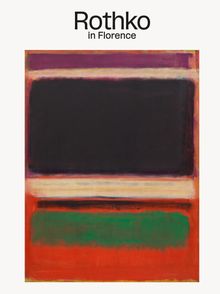
Published by Marsilio Arte. Edited by Christopher Rothko, Elena Geuna. Text by David Breslin, Gerhard Wolf, Marco Cianchi.
Published with Palazzo Strozzi.
This volume examines, for the first time, the American painter Mark Rothko's profound rapport with the city of Florence, following a route that starts in the rooms of Palazzo Strozzi and progresses toward two iconic locations, the Museo di San Marco, home to the frescoes of Fra Angelico, and the vestibule of the Biblioteca Medicea Laurenziana, designed by Michelangelo.Rothko's first encounter with Florence was in 1950, when he visited Italy with his wife, Mell. The trip marked the beginning of his fascination with the city's groundbreaking artists of the 14th, 15th and 16th centuries. Through an ample selection of works dating from the 1930s to 1970, Rothko in Florence explores Rothko's enchantment with the Renaissance, and in particular with the artists Giotto and Fra Angelico, while simultaneously tracing the course of his broader artistic, spiritual and cultural legacy. An exhaustive chronology, lavishly illustrated with images from the family archives, the volume unspools an underexplored facet of the great abstract artist's practice.Mark Rothko (1903–70) was born in imperial Russia and immigrated to the United States as a child. He studied at Yale University and became an instructor at the Center Academy of the Brooklyn Jewish Center. In the 1930s Rothko exhibited alongside his fellow members of the Ten, which included Louis Harris, Adolph Gottlieb and Joseph Solman. It was not until 1947 that his now-signature style—monochrome or multicolored rectangles against a solid background—began to coalesce.
Published by Pace Publishing. Text by Eleanor Nairne, Christopher Rothko.
This volume brings together key paintings from Rothko’s (1903–70) renowned body of work made in the late 1960s—a significant and prolific period in the artist’s life. In the wake of a particularly difficult bout of ill health, Rothko was forced to reduce the scale of his practice from his signature monumental canvas to more intimately sized paper. Despite physical limitations, Rothko worked feverishly with a renewed enthusiasm for color, delighted by the effect of acrylic paint, which he had newly discovered. In an intimate introduction, Christopher Rothko writes of the artist's shift in scale and the parallel between the viewer's experience with the paintings and his father's own creation of them. Eleanor Nairne explores Rothko's trajectory, tracing his early works and experience painting through the Seagram paintings and chapel commission to these works on paper. The book is produced on the occasion of the inaugural exhibition at Pace Gallery's new gallery space in London's Hanover Square.
Published by Hatje Cantz. Essays by Marjorie B. Cohn, Franz Meyer, Eliza E. Rathbone, Jeffrey Weiss and Oliver Wick.
Mark Rothko is one of the towering figures of Abstract Expressionism, and of twentieth-century painting as a whole. His paintings, predominantly in a large format and featuring horizontal layers of pigment on a monochrome foundation, occupy a permanent place in our collective pictorial memory as an epitome of heroic Modernism. This beautifully produced oversize monograph presents over 100 of his works in full-color plates. By considering Rothko's central groups of works from all creative periods--among them the Rothko Room in the Phillips Collection and the Harvard Murals at Harvard University--this book documents the artist's struggle to arrive at "a consummated experience between picture and onlooker." Rothko's adamant insistence on controlling the presentation of his works set him apart from the art scene as early as the 1950s. His pictures were to be hung closely together in small rooms, in which soft lighting and imposing scale were to provide an immediate viewing experience. This book attempts to recreate that atmosphere with a large, uninterrupted plate section that brings to life the vibrancy and power of these paintings. In addition to more than 100 color works, Mark Rothko includes essays about specific groups of work, an extensive, year by year, descriptive chronology of his life and work, and an exhaustive bibliography of writings about him from the past five years. It is an essential addition to any collection on twentieth-century art.
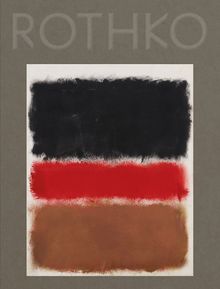 Mark Rothko: 1968 Clearing Away
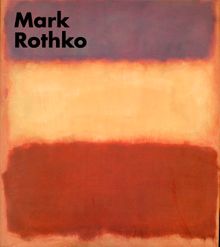 Mark Rothko