| |||||||||||||||||||||||||
ARTIST MONOGRAPHS
|
|
STATUS: Forthcoming | 11/3/2026 This title is not yet published in the U.S. To pre-order or receive notice when the book is available, please email orders @ artbook.com |
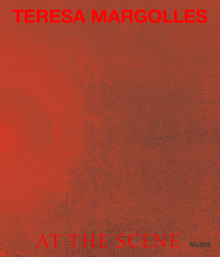 Teresa Margolles: At the Scene / En el lugar de los hechos
Published by The Museum of Modern Art, New York.
Edited with text by Inés Katzenstein, Ana Janevski. Text by Sayak Valencia.
For nearly 30 years, Teresa Margolles (born 1963) has gone where few artists have gone: investigating the social and aesthetic dimensions of conflict and violence, and creating sculptural installations, photographs, films and performances that bear witness to suppressed stories and unspeakable acts. Trained as a forensic pathologist, Margolles creates works that examine the implications of transnational violence through methodical research, site-specific interventions and a radical rethinking of the memorial. Her works often use found objects and seemingly ordinary materials like concrete and earth to make palpable the forces that underlie and enable violence, and to bring pressing systemic issues into the personal realm.
Published in conjunction with the first major survey of the artist’s work in the United States, presented at MoMA PS1 and the Museum of Modern Art, New York, this book is the most extensive exploration to date of her powerful practice, including close studies of her work on the US–Mexico border, drug trafficking and global migration, and Latin American feminism.
PUBLISHER
The Museum of Modern Art, New York
BOOK FORMAT
Hardcover, 9 x 10.5 in. / 160 pgs / 100 color.
PUBLISHING STATUS
Pub Date 11/24/2026
Forthcoming
DISTRIBUTION
D.A.P. Exclusive
Catalog: FALL 2026 p. 86
PRODUCT DETAILS
ISBN 9781633451902 TRADE
List Price: $55.00 CAD $77.00
AVAILABILITY
Awaiting stock
STATUS: Forthcoming | 11/24/2026 This title is not yet published in the U.S. To pre-order or receive notice when the book is available, please email orders @ artbook.com |
 Teresa Margolles: Ya Basta Hijos de Puta
Published by Silvana Editoriale.
Edited with text by Diego Sileo.
Characterized by a minimal yet vivid stylistic grammar and crude realism, the works of Mexican artist Teresa Margolles (born 1963) presented in this monograph contend with the prevalence of death and violence, particularly in contemporary Mexico, investigating them in connection with social and economic inequality.
PUBLISHER
Silvana Editoriale
BOOK FORMAT
Hardcover, 9 x 11 in. / 328 pgs / 300 color.
PUBLISHING STATUS
Pub Date 4/23/2019
Out of stock indefinitely
DISTRIBUTION
D.A.P. Exclusive
Catalog: FALL 2018 p. 195
PRODUCT DETAILS
ISBN 9788836639168 FLAT40
List Price: $60.00 CAD $84.00
AVAILABILITY
Not available
STATUS: Out of stock indefinitely. |
 Teresa Margolles: Frontera
Published by Walther König, Köln.
Text by Alpha Escobedo, Leobardo Alvarado, Rein Wolfs, Letizia Ragaglia.
PUBLISHER
Walther König, Köln
BOOK FORMAT
Clth, 6.75 x 9 in. / 144 pgs / 70 color.
PUBLISHING STATUS
Pub Date 2/29/2012
Out of print
DISTRIBUTION
D.A.P. Exclusive
Catalog: SPRING 2012 p. 110
PRODUCT DETAILS
ISBN 9783865609762 TRADE
List Price: $54.95 CAD $72.50
AVAILABILITY
Not available
STATUS: Out of print | 00/00/00 For assistance locating a copy, please see our list of recommended out of print specialists |
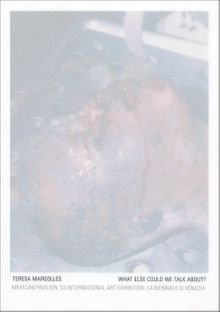 Teresa Margolles: What Else Could We Talk About?
Published by RM.
Edited by Cuauhtémoc Medina. Text by Taiyana Pimentel, Elmer Mendoza, Ernesto Diazmartínez, Teresa Margolles, Antonio Escohotado, Mariana Botey.
PUBLISHER
RM
BOOK FORMAT
Hardcover, 9.25 x 6.5 in. / 160 pgs / 48 color.
PUBLISHING STATUS
Pub Date 3/31/2010
Out of print
DISTRIBUTION
D.A.P. Exclusive
Catalog: SPRING 2010 p. 143
PRODUCT DETAILS
ISBN 9788492480661 TRADE
List Price: $35.00 CAD $47.50
AVAILABILITY
Not available
STATUS: Out of print | 00/00/00 For assistance locating a copy, please see our list of recommended out of print specialists |
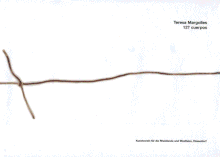 Teresa Margolles: 127 Cuerpos
Published by Walther König, Köln.
Text by Heriberto Yepez, Nike Bätzner, Patrizia Dander.
PUBLISHER
Walther König, Köln
BOOK FORMAT
Hardcover, 9.25 x 6.5 in. / 215 pgs / 165 color.
PUBLISHING STATUS
Pub Date 3/1/2007
Out of print
DISTRIBUTION
D.A.P. Exclusive
Catalog: SPRING 2007 p. 160
PRODUCT DETAILS
ISBN 9783925974663 TRADE
List Price: $61.00 CAD $82.50
AVAILABILITY
Not available
STATUS: Out of print | 00/00/00 For assistance locating a copy, please see our list of recommended out of print specialists |
 Teresa Margolles
Published by Hatje Cantz.
Essays by Santiago Sierra, Udo Kittelmann, Elmer Mendoza and Gabriela Jauregui.
PUBLISHER
Hatje Cantz
BOOK FORMAT
Hardcover, 6.5 x 9.5 in. / 256 pgs / 40 color / 10 bw.
PUBLISHING STATUS
Pub Date 8/2/2004
Out of print
DISTRIBUTION
D.A.P. Exclusive
Catalog: FALL 2004
PRODUCT DETAILS
ISBN 9783775714730 TRADE
List Price: $35.00 CAD $40.00
AVAILABILITY
Not available
STATUS: Out of print | 11/28/2010 For assistance locating a copy, please see our list of recommended out of print specialists |