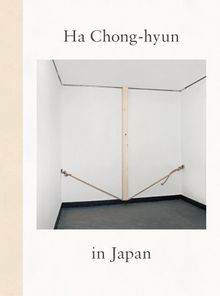
Shaped by his childhood experiences in Japan and his study of Mono-ha, Ha Chong-hyun's career underscores the twin developments of modern Japanese and Korean art
Hbk, 7.5 x 10 in. / 136 pgs / 68 color / 21 bw. | 3/10/2026 | In stock $45.00
Published by BLUM Books. Preface by Ashley Rawlings. Text by Kenji Kajiya, Toshiaki Minemura.
Korean artist Ha Chong-hyun (born 1935) has had a deep and enduring relationship with Japan, from his early years in Kansai to his first solo exhibition in Tokyo, introduced by his longstanding colleague Lee Ufan. His engagement with the Japanese avant-garde—particularly Mono-ha—shaped his early practice before he transitioned into the monochrome paintings that defined his role in Dansaekhwa. Featuring new essays alongside critical writings from past exhibition catalogs, this volume examines Ha's exhibitions at Muramatsu, Kamakura and other key Japanese galleries, as well as his lasting friendships with figures such as Lee and Nobuo Sekine. Archival materials, rare photographs and documentation from Japanese museum collections further illuminate Ha's impact and presence in Japan from the 1970s to the 2000s. More than a study of one artist, this book reveals the cross-cultural currents that connected Korean and Japanese modern art.
Published by Gregory R. Miller & Co.. Text by Sunjung Kim, Clara Kim, Yeon Shim Chung.
Predominantly known for his minimalist “Dansaekwha” paintings, South Korean artist Ha Chong-Hyun (born 1935) has spent six decades pioneering new forms in abstract painting. Initially working in oil, collage, and mixed media, since the 1970s Ha’s Conjunction series, colorful abstract works made by pushing thick oil paints through the back of coarse canvas to the front, have produced a wide array of textures and patterns that are entirely unique to his practice. This publication presents the work of the artist on the occasion of Ha’s landmark retrospective exhibition as part of the 59th Biennale di Venezia. A curated selection of more than 20 works produced from the 1960s through today shows the breadth of the artist’s creative experimentation in materials and methods, and is presented alongside images of the installation in Venice, essays, an illustrated historical timeline and artist biography.
 Ha Chong-Hyun