Emerging from the language-driven turn of 1960s visual art, Cointet’s codex simultaneously employs and obfuscates the logic of Conceptualism
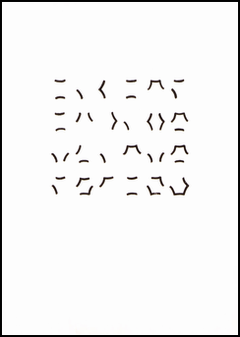
Originally self-published by Guy de Cointet (1934–83) in 1972, A Captain from Portugal is a short novel composed of the artist’s own coded letterforms. Printed in a hand-drawn, polygonal font, this artist’s book retains the formal logic of a standard paperback—including section breaks, illustrations and captions—that begs to be read like any other book. However, instead of standard literary fare, Cointet delivers a series of visually mesmerizing encrypted texts. Rather than alienating the reader, these texts pull them in through delicately arranged patterns, at times so intricate as to create a moiré effect on the page. Complementing these writings are additional boxlike codes, a short song presented in staff notation and several illustrations, a few of which point to the artist’s jagged, triangular drawings of the early 1980s.
FORMAT: Pbk, 5 x 7 in. / 50 pgs. LIST PRICE: U.S. $20.00 LIST PRICE: CANADA $28 ISBN: 9798994638194 PUBLISHER: Primary Information AVAILABLE: 10/13/2026 DISTRIBUTION: D.A.P. RETAILER DISC: TRADE PUBLISHING STATUS: Active AVAILABILITY: In stock TERRITORY: NA ONLY
Emerging from the language-driven turn of 1960s visual art, Cointet’s codex simultaneously employs and obfuscates the logic of Conceptualism
Originally self-published by Guy de Cointet (1934–83) in 1972, A Captain from Portugal is a short novel composed of the artist’s own coded letterforms. Printed in a hand-drawn, polygonal font, this artist’s book retains the formal logic of a standard paperback—including section breaks, illustrations and captions—that begs to be read like any other book. However, instead of standard literary fare, Cointet delivers a series of visually mesmerizing encrypted texts. Rather than alienating the reader, these texts pull them in through delicately arranged patterns, at times so intricate as to create a moiré effect on the page. Complementing these writings are additional boxlike codes, a short song presented in staff notation and several illustrations, a few of which point to the artist’s jagged, triangular drawings of the early 1980s.