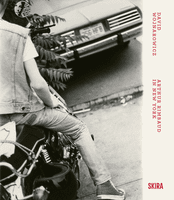
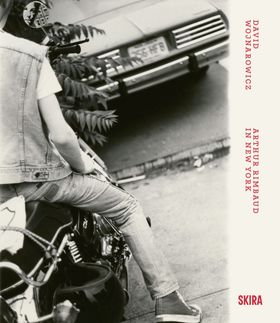
One of David Wojnarowicz's few incursions into photography is a testimony of urban, social and political change in New York in the late 1970s
In 1978 and 1979, David Wojnarowicz took a series of photographs of a man wearing a paper mask bearing the visage of Arthur Rimbaud, the French poet equally known for his fervid verse and dramatic life. Rimbaud was the instantiation, and perhaps the inventor, of the idea of the young gay hustler of genius. Presenting a selection of photographs by Wojnarowicz, this amply illustrated volume features an introductory essay by Antonio Sergio Bessa contextualizing the series within a foundation of other works across literature, photography and performance. Nicholas Martin explores Wojnarowicz's practice in the context of the rise of the punk movement in downtown Manhattan in the late 1970s. Craig Dworkin explores Rimbaud's years as a runaway youth in Paris during the Commune, and his acquaintances with the city's bohemia. Marguerite Van Cook contributes an essay about her experiences with the London and New York music and art scenes throughout the 1970s and 1980s. Phillip Aarons offers a personal account of his engagement as a collector of Wojnarowicz's work. The book also features an interview with photographer Allen Frame, who produced several performances of Wojnarowicz's monologues in the early 1980s in New York's Lower East Side, Berlin and Brooklyn. Painter, photographer, writer, filmmaker, performance artist, songwriter and activist David Wojnarowicz was born in Red Bank, New Jersey, in 1954 and died from AIDS-related illness in New York in 1992. He authored a few books, most famously Close to the Knives. Wojnarowicz attained national prominence as a writer and advocate for AIDS awareness and for his stance against censorship.
PRAISE AND REVIEWS
The New York Times: T List
Juan A. Ramirez
The works are both haunting and playful: a touching reminder that Wojnarowicz, who would go on to make some of the most striking protest art of the AIDS era before dying of complications from the disease, at age 37, was once just a kid who fanboyed over another artist.
AnOther Magazine
Sam Moore
On the surface, there might not be much in common between Rimbaud’s poetry and Wojnarowicz’s intense, politically furious collages and graffiti, but Wojnarowicz casts the poet as an outsider like himself, unable to find a concrete place in a world that seems more than willing to turn its back on him. This imbues the series with a haunted feeling; the unmoving face of Rimbaud becomes uncanny, ripped out of time.
4columns
Dave O'Neill
[The] book is a scholarly feat of the kind most galleries don’t bother with these days: Bessa’s insightful essay placing the series in conversation with artists from Vito Acconci to Sophie Calle; Nicholas Martin’s deep look at what Rimbaud meant to downtown artists; smart contributions from writers including Vitale, Craig Dworkin, Fiona Anderson, and more. Most movingly, Marguerite Van Cook recalls conversations with [Wojnarowicz], which, unlike mine, happened in the earthly realm.
Hyperallergic
Lavinia Liang
By reflecting and obscuring at once, Wojnarowicz reminds us how, in a world where governmental and corporate surveillance often blur into one another, we have to be innovative and unexpected in our resistance.
The Brooklyn Rail
Nathalie Prizel
The effacement that the mask of Rimbaud effects raises a host of questions: What does it mean to masquerade? Is it an act of cowardice, or a product of the closet? Does it enable a kind of truthfulness otherwise unavailable? One might recall Oscar Wilde’s aphorism, 'Man is least himself when he talks in his own person. Give him a mask, and he will tell you the truth.'
Huck magazine
Miss Rosen
[This] new book ... revisits [a] seminal chapter of the artist’s work, reading as both a living elegy as well as a premonition of things to come
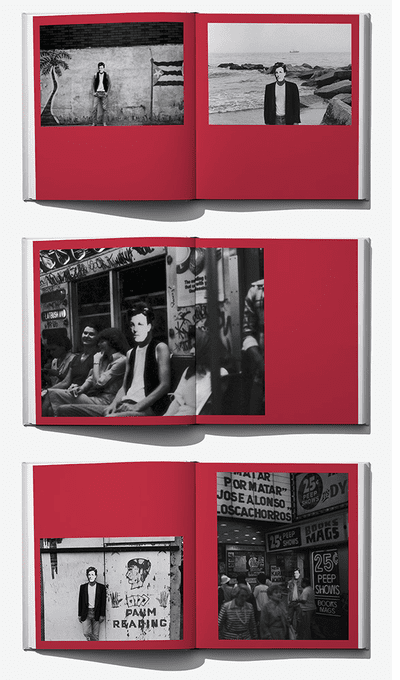
Featured spreads are from David Wojnarowicz: Arthur Rimbaud in New York, collecting the artist’s iconic photographs of a lone figure, disguised by a paper mask of the French miscreant poet Arthur Rimbaud, in a variety of down-and-dirty 1970s NYC urban landscapes. Published to accompany the acclaimed exhibition on view now at The Leslie-Lohman Museum of Art in New York, this is a must-have monograph for any photobook collector. “Rimbaud, the proto-punk grandfather of the East Village, embodies a movement of creatives who, like him, have run away as exiles,” Marguerite Van Cook writes, “—from families and societies that want everything to be confined to the literal, the documentable; from anything that is not experiential, or that exalts feelings. This is the vocabulary of the photographs in Arthur Rimbaud in New York. They offer an invocation for change, both artistic and social. Simultaneously and bizarrely, their anger aspires to beauty. The images represent a modern symbolism, reframed in a punk ethos which attempts to find its own aesthetic. Just as Rimbaud did, David seeks to form a new language through the creation of juxtapositions, images and snippets of text, and to expand the repressed vocabulary of sex and love.” continue to blog
FORMAT: Hbk, 9.5 x 11 in. / 208 pgs / 150 color. LIST PRICE: U.S. $55.00 LIST PRICE: CANADA $77 ISBN: 9788857254067 PUBLISHER: SKIRA AVAILABLE: 10/28/2025 DISTRIBUTION: D.A.P. RETAILER DISC: TRADE PUBLISHING STATUS: Active AVAILABILITY: In stock TERRITORY: NA ONLY
Published by SKIRA. Edited by Antonio Sergio Bessa.
One of David Wojnarowicz's few incursions into photography is a testimony of urban, social and political change in New York in the late 1970s
In 1978 and 1979, David Wojnarowicz took a series of photographs of a man wearing a paper mask bearing the visage of Arthur Rimbaud, the French poet equally known for his fervid verse and dramatic life. Rimbaud was the instantiation, and perhaps the inventor, of the idea of the young gay hustler of genius.
Presenting a selection of photographs by Wojnarowicz, this amply illustrated volume features an introductory essay by Antonio Sergio Bessa contextualizing the series within a foundation of other works across literature, photography and performance. Nicholas Martin explores Wojnarowicz's practice in the context of the rise of the punk movement in downtown Manhattan in the late 1970s. Craig Dworkin explores Rimbaud's years as a runaway youth in Paris during the Commune, and his acquaintances with the city's bohemia. Marguerite Van Cook contributes an essay about her experiences with the London and New York music and art scenes throughout the 1970s and 1980s. Phillip Aarons offers a personal account of his engagement as a collector of Wojnarowicz's work. The book also features an interview with photographer Allen Frame, who produced several performances of Wojnarowicz's monologues in the early 1980s in New York's Lower East Side, Berlin and Brooklyn.
Painter, photographer, writer, filmmaker, performance artist, songwriter and activist David Wojnarowicz was born in Red Bank, New Jersey, in 1954 and died from AIDS-related illness in New York in 1992. He authored a few books, most famously Close to the Knives. Wojnarowicz attained national prominence as a writer and advocate for AIDS awareness and for his stance against censorship.