Alfredo Jaar & Jacques Rancière: The Power of Words
Conversation with Jacques Rancière, Alfredo Jaar.
Conveying pain without text, Jaar’s photographic assemblages express, as Jacques Rancière says, “not the thing but the effect it produces”
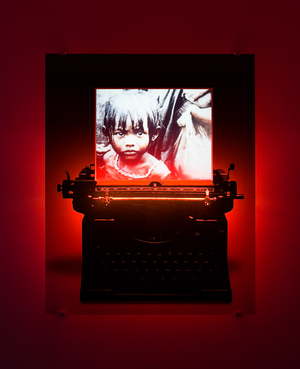
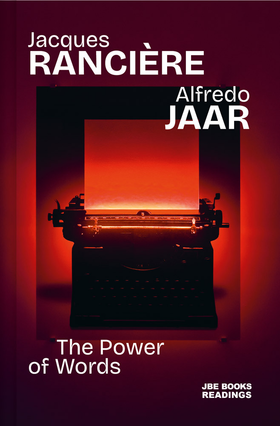
For over 40 years, Chilean artist, architect and filmmaker Alfredo Jaar (born 1956) has worked across photography, film and installation to probe complex sociopolitical issues and questions of representation. This volume revisits Jaar’s seminal installation, The Power of Words (1984), which interrogates the production, dissemination and consumption of images of human suffering. The piece features a photographic reproduction of a typewriter that projects 16 press photos in lieu of text. Red neon light floods each image, warning the viewer of the sensitive material depicted. No text figures in the installation, leaving the evocative scenes decontextualized. The installation’s title, then, is ironic. In Jaar’s view, photography had supplanted text as the primary vehicle of mass communication to hazardous effect. In addition to full-page illustrations, this volume features a discursive conversation between the artist and French philosopher Jacques Rancière, whose thought has long guided Jaar’s practice.
FORMAT: Pbk, 5 x 7.5 in. / 82 pgs / 23 color / 2 b&w. LIST PRICE: U.S. $19.95 LIST PRICE: CANADA $27.95 ISBN: 9782365681384 PUBLISHER: JBE Books AVAILABLE: 9/29/2026 DISTRIBUTION: D.A.P. RETAILER DISC: TRADE PUBLISHING STATUS: Active AVAILABILITY: In stock TERRITORY: NA LA ASIA AU/NZ
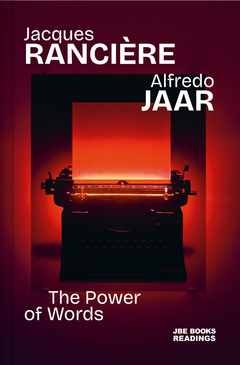
Alfredo Jaar & Jacques Rancière: The Power of Words
Published by JBE Books. Conversation with Jacques Rancière, Alfredo Jaar.
Conveying pain without text, Jaar’s photographic assemblages express, as Jacques Rancière says, “not the thing but the effect it produces”
For over 40 years, Chilean artist, architect and filmmaker Alfredo Jaar (born 1956) has worked across photography, film and installation to probe complex sociopolitical issues and questions of representation. This volume revisits Jaar’s seminal installation, The Power of Words (1984), which interrogates the production, dissemination and consumption of images of human suffering. The piece features a photographic reproduction of a typewriter that projects 16 press photos in lieu of text. Red neon light floods each image, warning the viewer of the sensitive material depicted. No text figures in the installation, leaving the evocative scenes decontextualized. The installation’s title, then, is ironic. In Jaar’s view, photography had supplanted text as the primary vehicle of mass communication to hazardous effect. In addition to full-page illustrations, this volume features a discursive conversation between the artist and French philosopher Jacques Rancière, whose thought has long guided Jaar’s practice.