Edited by Francis Schichtel, Jordan Weitzman, Nan Goldin. Text by Hilton Als.
Lankton's iconic and startling doll sculptures as we have never seen them before: through her own eyes
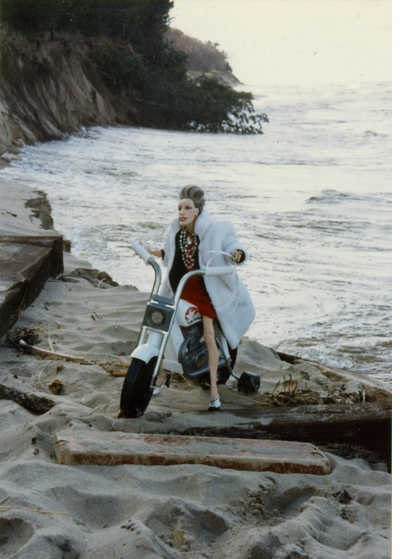
This is the first monograph on the trans visionary artist Greer Lankton (1958–96), whose lifelike doll sculptures shocked 1980s New York. Lankton's dolls, which she began making as a child and produced obsessively until her death at age 38, were a means to explore her fraught relationship with the human body. In the book's 100 photographs, all shot by Lankton herself, these figures take on a life of their own, kvetching at a party, strolling along a beach, or lounging on a stoop in the East Village. Among this extraordinary cast of oddballs—usually femme, often freakish, always radiating a glamorous confidence—we find characters of Lankton's own invention alongside well-known icons such as Divine, Coco Chanel, Andy Warhol and even Lankton herself. Born in 1958 to a Presbyterian minister in Michigan, Greer Lankton moved to New York in 1978 and became a rising star of the downtown scene. There, her deviant elegance was immortalized in photographs by Peter Hujar, David Armstrong and Lankton's close friend Nan Goldin, who described her as "one of the luminaries of the East Village renaissance: beautiful, glamorous, wild and hysterically funny." Lankton's work was a neighborhood fixture, in exhibitions at the gallery Civilian Warfare and in regular window displays at Einstein's Boutique, and was also celebrated farther afield, in era-defining group shows at PS1 and the Venice Biennale. Her final work, an immersive installation created for the Mattress Factory in 1996, remains on permanent view.
PRAISE AND REVIEWS
New York Times: T Magazine
Nick Haramis
Since Lankton’s death, she’s emerged as an unlikely hero: an endlessly imaginative mind who, like her peers Andy Warhol and David Wojnarowicz, created a distinct identity for herself as an artist; a transgender woman persevering in a narrow-minded world; a survivor, not just of discrimination or neglect but of history’s attempts to minimize her contributions to contemporary art. Now, Lankton is getting her due...
Dazed
Summer Moraes
For Lankton, dolls were more than just kitschy objects – they were powerful, emotional extensions of herself.
Vogue
Fiorella Valdesolo
As the pace of information and images being thrown at us in our daily lives continues to pick up speed, [Gabriele Munter's] art, and the slow, introspective looking it invites us to do, feels like an antidote.
Flaunt magazine
Abby Shewmaker
In a digital era where identity is filtered and flattened, Lankton’s work pulses with something defiantly analog, defiantly alive. The body—hers, ours, theirs—remains both masterpiece and battleground, forever whispering the question: Who made me, and what am I becoming?
Cultured
Johanna Fateman
Could It Be Love' is a gift (and imminently giftable), gathering together the artist’s own images—moody vignettes, raucous group portraits, and exquisite close-ups of her dolls—for a thrillingly intimate experience of her glamorous, tormented, and enchanted worlds.
The Brooklyn Rail
Louis Shankar
Could It Be Love' is the first monograph dedicated to Lankton’s art, produced with the Mattress Factory’s archive (not G.L.A.M.). It collects together over one hundred photographs taken by Lankton of her dolls, carefully posed and artfully staged: these aren’t installation photographs, never do we see the white walls of a gallery.
Huck magazine
Miss Rosen
Lankton channelled her trauma and experience into the work, the dolls becoming repositories of soul that beckon viewers into a strange and curious realm .... The dolls became avatars, not only of the characters they represent, but of the complexities of the human condition where beauty and brokenness co-exist in an endless spiral of remaking ourselves.
“They’re all freaks. Outsiders, untouchables. They’re like biographies, the kind of people you’d like to know about. Really interesting and fucked up. It’s what you want to read, the kind of people you stop and notice.” So Greer Lankton is quoted in Pride Month Staff PickCould It Be Love, published by Magic Hour Press in collaboration with the Greer Lankton Collection and The Mattress Factory in Pittsburgh. Featuring 100 color photographs by Lankton of her iconic doll sculptures in uncanny, real-life scenarios—some glamorous, some humorous, some heartbreaking—this gem of a book also collects an assortment of portraits of Lankton herself, shot by Nan Goldin, Peter Hujar and David Armstrong during her short lifetime, with text by Hilton Als. Featured here, Grandma Tillie. continue to blog
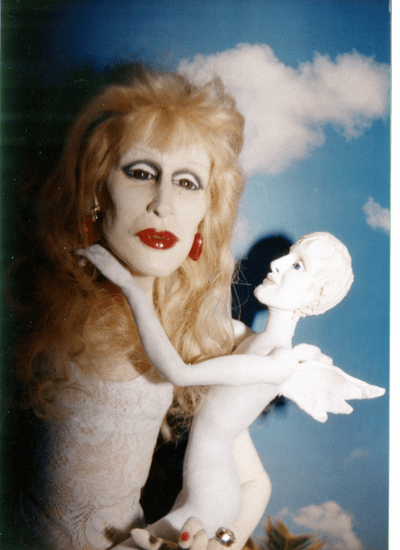
With voluminous hair and an adoring Eros around her neck, the mystique of Candy Darling is rendered in doll form in this enigmatic work by Greer Lankton (1958–1996). Darling is only one of many characters depicted in Greer Lankton: Could It Be Love, the first-ever monograph on this visionary trans artist and a thorough labor of love from publisher Magic Hour Press. Not only fabricated, but photographed, by Lankton herself, the images narrate her community’s fraught relationship with the body, their grotesque forms weaving together autobiographical narratives of disordered eating, depression, drug addiction and AIDS. With garish expressions, irreverent confidence and dark humor, the characters—both famous figures and original creations—tell a visual story of both Lankton’s own psyche and the 1980s East Village scene. Even among that illustrious circle, which included Peter Hujar, David Armstrong and Nan Goldin (who contributes an essay to this book), Lankton was a thrilling artist, who had obsessively perfected her dollmaking skills as an escape into others’ lives since childhood. Hilton Als puts it succinctly in his essay, describing, “her dolls’ attenuated limbs stretching this way and that, and those incredible faces, the manifestation of some dream of femaleness, usually, that reflected Greer’s own ideas about her own femaleness, a hard journey that didn’t make her any happier but gave her herself, a maker of females in her own emotional image.” continue to blog
Published by Magic Hour Press. Edited by Francis Schichtel, Jordan Weitzman, Nan Goldin. Text by Hilton Als.
Lankton's iconic and startling doll sculptures as we have never seen them before: through her own eyes
This is the first monograph on the trans visionary artist Greer Lankton (1958–96), whose lifelike doll sculptures shocked 1980s New York. Lankton's dolls, which she began making as a child and produced obsessively until her death at age 38, were a means to explore her fraught relationship with the human body. In the book's 100 photographs, all shot by Lankton herself, these figures take on a life of their own, kvetching at a party, strolling along a beach, or lounging on a stoop in the East Village. Among this extraordinary cast of oddballs—usually femme, often freakish, always radiating a glamorous confidence—we find characters of Lankton's own invention alongside well-known icons such as Divine, Coco Chanel, Andy Warhol and even Lankton herself.
Born in 1958 to a Presbyterian minister in Michigan, Greer Lankton moved to New York in 1978 and became a rising star of the downtown scene. There, her deviant elegance was immortalized in photographs by Peter Hujar, David Armstrong and Lankton's close friend Nan Goldin, who described her as "one of the luminaries of the East Village renaissance: beautiful, glamorous, wild and hysterically funny." Lankton's work was a neighborhood fixture, in exhibitions at the gallery Civilian Warfare and in regular window displays at Einstein's Boutique, and was also celebrated farther afield, in era-defining group shows at PS1 and the Venice Biennale. Her final work, an immersive installation created for the Mattress Factory in 1996, remains on permanent view.