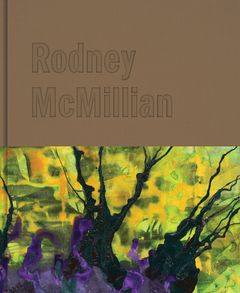
Edited with text by Michael Neumeister. Text by Sadé Ayorinde, Nikita Gale, Abbe Schriber, Brooke Wyatt.
"McMillian endows simple objects with affecting political resonances...There is anger in them, but there is hope too." —Frieze
Published with Columbia Museum of Art.
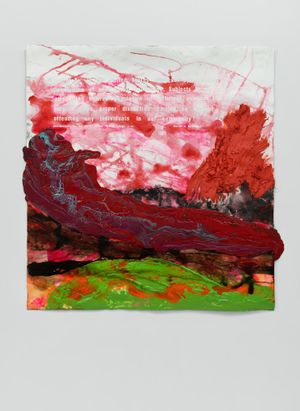
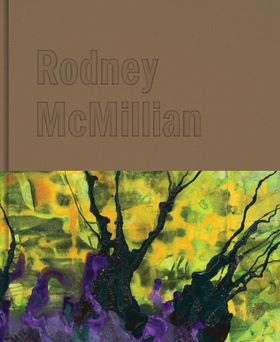
Multimedia artist Rodney McMillian (born 1969) conjoins political texts, found domestic materials and archival footage into assemblages that confront the complex histories of class, race, landscape and region that inform American identity. In A Son of the Soil, McMillian trains his eye on the history of landscape representation in the South. Through large-scale abstract expanses painted on old bedding, sculptures constructed from post-consumer objects and archival film footage, McMillian evokes the land's tillage and spoilage, histories of ownership and the charged relationship between land and the body. A Son of the Soil presents a bevy of scholarly essays that examine McMillian's oeuvre, focusing on the artist's interplay between urban industrialism and domestic space, his visual culture and art historical sources and, more broadly, the relationship between a region and a nation.
Published by Marquand Books. Edited with text by Michael Neumeister. Text by Sadé Ayorinde, Nikita Gale, Abbe Schriber, Brooke Wyatt.
"McMillian endows simple objects with affecting political resonances...There is anger in them, but there is hope too." —Frieze
Published with Columbia Museum of Art.
Multimedia artist Rodney McMillian (born 1969) conjoins political texts, found domestic materials and archival footage into assemblages that confront the complex histories of class, race, landscape and region that inform American identity. In A Son of the Soil, McMillian trains his eye on the history of landscape representation in the South. Through large-scale abstract expanses painted on old bedding, sculptures constructed from post-consumer objects and archival film footage, McMillian evokes the land's tillage and spoilage, histories of ownership and the charged relationship between land and the body. A Son of the Soil presents a bevy of scholarly essays that examine McMillian's oeuvre, focusing on the artist's interplay between urban industrialism and domestic space, his visual culture and art historical sources and, more broadly, the relationship between a region and a nation.