Lasker's postmodern abstraction meets the Frye collection's turn-of-the-century representation
Published with Frye Art Museum.
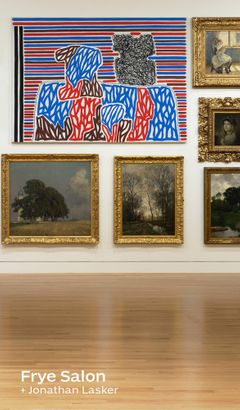
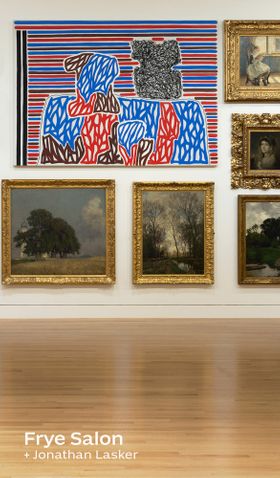
Since the late 1970s, American painter Jonathan Lasker (born 1948) has cultivated a distinct formal vocabulary of structural grids, graphic scribbled lines and thick impasto strokes of paint. Lasker employs the familiar tools of representational painting—figure and ground, space and perspective—to destabilize its dividing line with abstraction. In keeping with Lasker's line of formal inquiry, this compact volume presents an unlikely yet productive pairing: a selection of the artist's large canvases intermingled with the Frye Art Museum's collection of late 19th- and early 20th-century paintings. Embedded within the museum's salon, Lasker's compositions open unexpected conversations across time, style and painterly intent. The publication includes photographs of the exhibition, as well as a foreword by collector Judy Greenstein, an essay by director Jamilee Lacy that discusses the exhibition in the context of Lasker's overall practice, and an interview between the artist and Lacy.
Published by Marquand Books. Edited by Jamilee Lacy.
Lasker's postmodern abstraction meets the Frye collection's turn-of-the-century representation
Published with Frye Art Museum.
Since the late 1970s, American painter Jonathan Lasker (born 1948) has cultivated a distinct formal vocabulary of structural grids, graphic scribbled lines and thick impasto strokes of paint. Lasker employs the familiar tools of representational painting—figure and ground, space and perspective—to destabilize its dividing line with abstraction. In keeping with Lasker's line of formal inquiry, this compact volume presents an unlikely yet productive pairing: a selection of the artist's large canvases intermingled with the Frye Art Museum's collection of late 19th- and early 20th-century paintings. Embedded within the museum's salon, Lasker's compositions open unexpected conversations across time, style and painterly intent. The publication includes photographs of the exhibition, as well as a foreword by collector Judy Greenstein, an essay by director Jamilee Lacy that discusses the exhibition in the context of Lasker's overall practice, and an interview between the artist and Lacy.