Published by The Museum of Modern Art, New York. Introduction by Sarah Hermanson Meister.
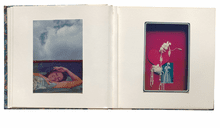
Italian photographer Luigi Ghirri (1943–92) made Cardboard Landscapes (Paesaggi di cartone) during his travels around Europe, coining the term “sentimental geography” to describe his unique artistic approach of examining the ordinary to prove it remarkable. The original handmade album features over 100 chromogenic color prints pasted onto the pages of a blank book, and was gifted by Ghirri to John Szarkowski, then the Director of the Department of Photography at the Museum of Modern Art, in the 1970s.
A singular work of art, Cardboard Landscapes is now being published for the first time. The collection is an anomaly within Ghirri’s overall oeuvre, as it prioritizes complex composition rather than the sweeping tableaux for which he is best known. In this series of works, he regards the printed image as the subject, framing a kaleidoscope of photographs and advertisements to tell a poetic visual narrative that reflects at once regional, personal and popular culture, revealing a fascinating impulse to investigate his role within his own medium.
Luigi Ghirri (1943–92) was a celebrated Italian artist and photographer known for his color photographs of landscape and architecture. He published his first photography book, Kodachrome, in 1978, and continued to utilize a conceptual framework to interrogate the line between fiction and reality.
Published by JRP|Ringier. Edited by Elena Re. Text by Andrea Bellini, Luigi Ghirri, Paola Ghirri, Massimo Minimi, Elena Re.
The color photographs of Luigi Ghirri (born 1943) revolutionized Italian photography in the 1970s with their gentle humor and appearance of compositional ease. Often compared with the snapshot compositions of Lee Friedlander or William Eggleston, Ghirri’s photographs, often verging on the surreal with their imaginative framing devices and visual puns, placed him in a category all his own. In the early 1980s, Ghirri began to use a medium-format camera that allowed him to produce large, richly textured negatives from whose contact sheets he would extract individual shots. He would then rearrange these small images in various permutations. These “project prints” enabled Ghirri to organize his work in a format that he maintained from the early 1980s until his death in 1992. They are now published for the first time in this volume.

 Luigi Ghirri: Project Prints