Published by Hatje Cantz. Edited by Ulrich Luckhardt, Christian Ring. Text by Caroline Dieterich, Daniel J. Schreiber, Roman Zieglgänsberger.
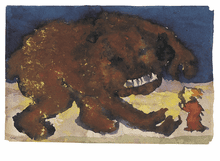
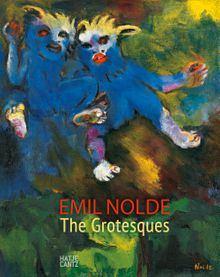
Emil Nolde (1867–1956) is famous for his dramatic ocean views and colorful flower gardens, but his love of the fantastical and grotesque has received less attention. Yet it is clear from his autobiography and his letters that they had a significant impact on his art. Alongside his first oil painting, “Bergriesen” (“Mountain Giants,” 1895–96), his alpine postcards of this period, in which the Swiss mountains appear as bizarre human physiognomies, also convey his fascination with the fantastical. His rejection of realism in favor of a grotesque, alternative world can be seen throughout his oeuvre, from its beginnings to the Grotesken (1905) and watercolors from 1918–19, to the years under the Nazis when he was forbidden to practice his profession. This catalog, which includes works never before shown, is also the first to emphasize this fascinating side of the great painter and water-colorist.
Published by Hatje Cantz. Edited by Brigitte Reinhardt. Essays by Tilman Osterwold, Manfred Reuther, et al.
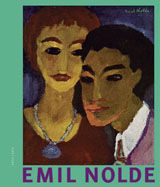
Emil Nolde is one of the foremost German Expressionist painters. Portraits play a prominent role in the artist's oeuvre, particularly those of his early creative period. During those years in which Nolde's art developed to maturity, his painting was enriched by an innovative power that inspired later artists well into the twentieth century. Some 60 of the unparalleled portraits completed by Emil Nolde between 1903 and 1918 are presented and described in this book. These works include the masterful self-portraits of 1916-17, the famous double portrait “Brother and Sister” of 1918, and his portrait-style images of people he encountered while traveling in New Guinea from 1913 to 1914. The autonomy and immediacy of Nolde's painting is particularly evident in these works. Fascinated by the obscure inner-stirrings of human identity, he developed an unusual gestural mode of painting.
Published by Hatje Cantz. Edited by Tilman Osterwold. Essays by Thomas Knubben, Jolanthe Nolde, Manfred Reuther,
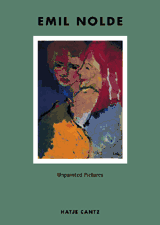
Unpainted Pictures is the title of a fascinating watercolors series painted by Emil Nolde from 1938 through 1945. Nolde created these works in the seclusion of his own home in Seebll, after his works had been confiscated by the Nazis and he himself had been forbidden to paint. He lent many of them to friends for safekeeping, in order to protect himself and his art from Gestapo raids. These small, free, imaginative works were ''unpainted'' in the sense that they did not officially exist and were not supposed to exist--also, Nolde hoped to expand on them at a later date. He never offered any of these watercolors for sale, and today this collection--which has become, for many, the summary and epitome of his work--resides at the Nolde Foundation in Seebll. All of the 104 watercolors in the series are presented here, along with a journal, consisting of dated notes, thoughts, questions and dreams, which forms a record of the period in which the Unpainted Pictures were being created. Gorgeous, diverse and quietly moving, these Unpainted Pictures continue to be nothing short of a revelation.
 Emil Nolde: Eye Contact
 Emil Nolde: Unpainted Pictures