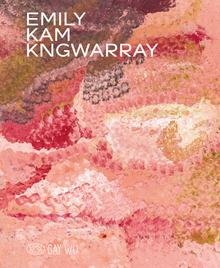
Published by JRP|Editions. Edited with text by Georges Petitjean, Bérengère Primat. Text by Kelli Cole, Stephen Gilchrist, Jennifer Green.
Published with Fondation Opale.
This new volume of the Gay'Wu series, dedicated to Aboriginal arts and knowledge and published with the Swiss Fondation Opale, explores the unique practice of Anmatyerr artist Emily Kam Kngwarray, one of the most significant painters of the late 20th century. Her works, produced almost entirely in the final eight years of her life, resist containment within Western art-historical categories. They are neither abstract nor figurative in any conventional sense, neither modern nor contemporary in a linear chronology. Rather, they operate as cultural acts and visual expressions of her country, Anmatyerr law and ancestral knowledge, activated through her artistic practice. She first encountered batik in the late 1970s within the Utopia community, before turning to acrylic paint on canvas in the late 1980s. Her early works are characterized by chromatic vibrations in a restrained palette. In the final years of her life, she underwent a radical stylistic shift toward powerful compositions of lines, and an expanded use of color. Layered motifs represent the distinct wildlife and topography of the desert ecosystems around her, depicting vines, seeds, lizards and emus with expressive and gestural marks. Born in the Sandover region of Australia's Northern Territory, Emily Kam Kngwarray (ca. 1914–96) began painting at around the age of 74. Though active for less than a decade, she created an estimated 3,000 works. She posthumously represented Australia at the 1997 Venice Biennale.