Edited with text by Ian Berry, Michael Duncan. Text by Cynthia Burlingham, Alexandra Carrera, Megan Hyde. Contributions by Julie Ault, Jason Simon, Juliette Bellocq, Aaron Rose, Karen Carson, Ciara Phillips, Lorraine Wild, Lari Pittman, Deborah Kass, Roy Dowell, Andrea Bowers, Pae White, Steve Hurd, Carrie Moyer, Sheila Pepe, Jim Isermann, Mike Kelley, Barbara Loste, Frances Snyder, Jim Hodges.
Four decades of impassioned art-activism from the beloved radical Catholic nun, educator and graphic artist—her definitive monograph available once more
Hbk, 13 x 10 in. / 256 pgs / 330 color / 41 bw. | 2/3/2026 | In stock $65.00
Published by DelMonico Books. Edited with text by Ian Berry, Michael Duncan. Text by Cynthia Burlingham, Alexandra Carrera, Megan Hyde. Contributions by Julie Ault, Jason Simon, Juliette Bellocq, Aaron Rose, Karen Carson, Ciara Phillips, Lorraine Wild, Lari Pittman, Deborah Kass, Roy Dowell, Andrea Bowers, Pae White, Steve Hurd, Carrie Moyer, Sheila Pepe, Jim Isermann, Mike Kelley, Barbara Loste, Frances Snyder, Jim Hodges.
Published with Tang Museum at Skidmore College.
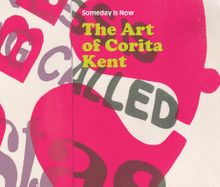
For Corita Kent, printmaking was a populist medium to communicate with the world around her. This activist spirit came most alive in the 1960s, when her posters and murals addressed subjects such as racism and poverty, US military brutalities in Vietnam and conflicts between radical and conservative positions in the Catholic Church. Her posters, murals and signature serigraphs combined messages of love and faith with images from popular culture and inventive use of type and color. Originally published in 2013 and long out of print, the most comprehensive monograph on Kent's work finally returns in a brilliant showcase of prints and ephemera from all phases of her life, revealing her importance as an activist printmaker and a stylistic innovator in graphic design. It includes not just the 1960s serigraphs for which she is best known, but also early abstractions and text pieces as well as lyrical works made in the 1970s and 1980s. Full of the lively, colorful work that is so iconically hers, this volume presents four decades of a life dedicated to serving others through and with the language of art. Someday is Now is punctuated by scholarship, selected writings by Kent herself, interviews with former students and collaborators, and responses to her work from a wide variety of artists, curators and designers. Artist, activist, teacher and devout Catholic Corita Kent (1918–86) eloquently combined her passions for faith and politics during her rich and varied career. As a teacher at Los Angeles' Immaculate Heart College, she fostered a creative and collaborative arts community and developed an interest in printmaking. By 1968, her art was enormously popular. She remained active in social causes until her death in 1986.
Published by J&L Books/Magic Hour Press. Edited by Julie Ault, Jason Fulford, Jordan Weitzman. Text by Olivian Cha.
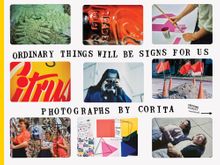
Corita Kent, formerly Sister Mary Corita, is known for her exuberant, colorful serigraphs and her teaching, as evidenced in her lively art classes. As a Catholic nun from 1936 until 1968, Corita lived and worked in the Immaculate Heart of Mary community in Los Angeles. She taught lettering and layout, image finding, and art structure for 20 years in Immaculate Heart College’s art department. There, she screened multiple films simultaneously, hosted guest thinkers including Saul Bass, Buckminster Fuller and John Cage, and guided the making of large-scale collaborative projects with students. Corita regularly took her students out for looking sessions at a used car lot or an art exhibition. While constantly looking and discovering visually, Corita shot thousands of 35 mm slides documenting references, the IHC milieu and the art department processes. For Corita, the vernacular environs of advertising, supermarkets and the city’s media landscape were a source of inspiration and raw material. Her slide collection encompasses a wide range of subjects: cookies, coke bottles, toys, presents, experiments, projects, Mary’s Day celebrations stemming from Corita’s classroom, flowers, magazines, seeds, puppets, visits with Charles and Ray Eames, street signs, trade fairs, folk art, boxes, billboards and kites. Drawing from the Corita Art Center’s vast slide collection, Ordinary Things Will Be Signs for Us embodies Corita’s philosophy of looking. Corita Kent (1918–86) was known for her iconic art, innovative teaching methods and messages of social justice. Born Frances Elizabeth Kent in Fort Dodge, Iowa, she entered the order of the Immaculate Heart of Mary in Hollywood at age 18. As a professor and later chair of the art department, she helped establish its reputation as a hub of creativity and liberal thinking. By 1968, her art was enormously popular, showing in more than 230 exhibitions and held in public and private collections around the world. She remained active in social causes until her death in 1986.
Published by Atelier Éditions. Introduction by Ray Smith. Foreword by Aaron Rose.
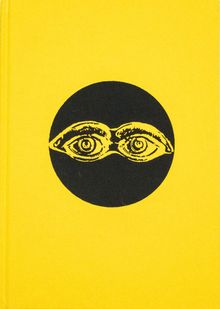
Radical American artist, educator and Catholic nun, Corita Kent’s (1918–86) provocative and elaborate serigraphy has entranced audiences for over four decades. Originally completed in 1968, Kent’s International Signal Code Alphabet encompasses a series of 26 kaleidoscopic serigraphs integrating scripture, typography, image, icon and the maritime flags of the International Code of Signals.
As 2018 marks the 50th anniversary of both the series’ completion and the centennial of Kent’s birth, this celebratory publication, produced in collaboration with the Corita Art Center, reproduces for the first time the International Signal Code Alphabet in this handsome and eye-grabbing yellow clothbound volume.
An informative introduction written by Corita Art Center Director, Ray Smith, and a foreword authored by artist and curator Aaron Rose accompany the serigraphs.
Published by Four Corners Books. Text by Julie Ault, Daniel Berrigan.
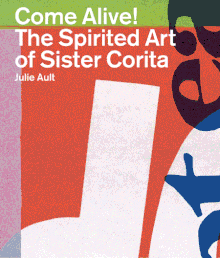
At 18, Corita Kent (1918-86) entered the Roman Catholic order of Sisters of the Immaculate Heart of Mary in Los Angeles, where she taught art and eventually ran the art department. After more than 30 years, at the end of the 1960s, she left the order to devote herself to making her own work. Over a 35-year career she made watercolors, posters, books and banners--and most of all, serigraphs--in an accessible and dynamic style that appropriated techniques from advertising, consumerism and graffiti. The earliest, which she began showing in 1951, borrowed phrases and depicted images from the Bible; by the 1960s, she was using song lyrics and publicity slogans as raw material. Eschewing convention, she produced cheap, readily available multiples, including a postage stamp. Her work was popular but largely neglected by the art establishment--though it was always embraced by such design luminaries as Charles and Ray Eames, Buckminster Fuller and Saul Bass. More recently, she has been increasingly recognized as one of the most innovative and unusual Pop artists of the 1960s, battling the political and religious establishments, revolutionizing graphic design and making some of the most striking--and joyful--American art of her era, all while living and practicing as a Catholic nun. This first study of her work, organized by Julie Ault on the 20th anniversary of Kent's death, with essays by Ault and Daniel Berrigan, is the first to examine this important American outsider artist's life and career, and contains more than 90 illustrations, many of which are reproduced for the first time, in vibrant, and occasionally Day-Glo, color.
 Corita Kent: Ordinary Things Will Be Signs for Us
 Corita Kent: International Signal Code Alphabet
 Come Alive!: The Spirited Art of Sister Corita