Best known for her landmark publication, the Situationist Times, de Jong now receives a survey dedicated to her avant-garde practice beyond the printed page
Hbk, 8.5 x 11 in. / 176 pgs / 120 color. | 10/28/2025 | In stock $50.00
Playful, erotic, dark and radically contemporary, de Jong's idiosyncratic oeuvre exposed society's dark undercurrents in the hope of a more humane world
Clth, 9 x 12.5 in. / 280 pgs / 245 color / 20 bw. | 1/20/2026 | In stock $55.00
Published by JRP|Editions. Edited with text by Melanie Bühler. Foreword by Gianni Jetzer. Text by Paul Bernard, Jacqueline de Jong, Karen Kurczynski, Emily LaBarge, Tiana Reid, McKenzie Wark.
Published with Kunstmuseum St. Gallen.
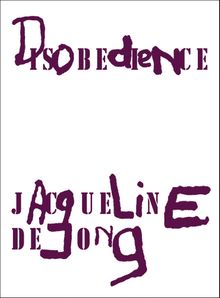
Published to accompany the artist's retrospective at the Kunstmuseum St. Gallen, Disobedience encapsulates the oeuvre of Dutch artist Jacqueline de Jong (1939–2024), a member of the Situationist International who experimented with art brut, Pop art, New Figuration, postmodernism and countless other movements over her 60-year career. Her art was dedicated to revealing the hidden undercurrents—eroticism, violence, fear, agony and lust—and, with a sense of play and pleasure, reinterpreting them so that a radical, more honest version of humanity might emerge. This publication spans de Jong's entire artistic journey, from her editorial activities of the 1960s to her Billiards series in the 1970s, and her final works in the early 2020s. Organized through six sections entitled "Disobedience," "Publishing," "Chaos," "Pop," "Play" and "Politics," it underlines the challenging approach to art and life developed by de Jong formally, visually and conceptually from the early 1960s until 2024.
Published by SKIRA. Edited with text by Ariella Wolens. Text by Alison M. Gingeras, Margriet Schavemaker.
Until recently, Dutch artist Jacqueline de Jong (1939–2024) has primarily been recognized for her role as founder and editor of the seminal artist's magazine, the Situationist Times (1962–67). This exhibition catalog, marking the first institutional presentation since the artist's death last year, considers de Jong's dynamic practice beyond the 1960s, touching on her interpretations of movements such as CoBrA, Fluxus, Neo-Expressionism and more. Alongside examples of her paintings, drawings and sculptures, it also includes reproductions of unpublished ephemeral material held in de Jong's archive at Yale University's Beinecke Rare Book and Manuscript Library, along with newly commissioned texts written in memoriam and de Jong's final interview. Vicious Circles highlights de Jong's engagement with diverse art movements and also addresses her legacy as a key figure within the history of counterculture publishing, highlighting her role as editor, publisher and designer.
 Jacqueline de Jong: Vicious Circles