Published by Walther König, Köln. Edited with text by Mathieu Copeland.
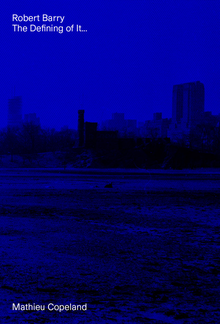
At over 500 pages, The Defining of It… is the first comprehensive monograph to explore the Minimalist and Conceptualist work of Robert Barry (born 1936), a member of New York's avant-garde art scene best known for his language-based works and artist's books. Spanning from Barry's formative years in the 1950s to his pivotal contributions to Minimalism and Conceptualism in the latter half of the 20th century, this landmark publication offers an unprecedented look at the artist's evolution and legacy. Developed in close collaboration with the artist, the book presents a critical and far-reaching analysis of Barry's work alongside a rich and largely unpublished iconography sourced from international collections and the artist's personal archives.
Since 1967 the American conceptualist Robert Barry has taken his work to the limits of immateriality and invisibility, creating installations with wire and nylon thread, performing actions with inert gasses and radioactive materials and going on to work with acoustic frequencies, sounds and language. This volume documents a recent site-specific work.
The full title to this volume on Robert Barry's rarely-shown early work reads: Some places to which we can come, and for a while “be free to think about what we are going to do.” This might further be understood by a typical example of Barry's work, which he designed for the sixth issue of Vito Acconci's magazine 0-9 in 1969. The contribution consisted of the following brief description: The space between pages 29 and 30 / The space between pages 74 and 75. This long-awaited volume on the early work of the New Jersey-based Conceptual artist reveals much of the work that was at the heart of the beginnings of American Conceptual art, of which Barry was a main protagonist. As early as 1967 he began working towards the limits of immateriality and invisibility, creating installations out of wire and nylon thread, performing with gases, working with acoustic frequencies and language, and producing slide projections--much of which is documented here, together with new essays on the artist's work.
 Robert Barry: Real ...... Personal
 Robert Barry: Some Places To Which We Can Come 1963-1975