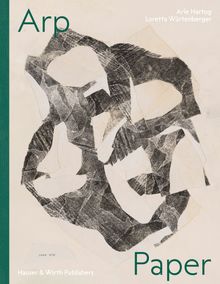
Published by Hauser & Wirth Publishers. Text by Arie Hartog, Loretta Würtenberger.
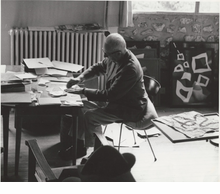
Best known for his two- and three-dimensional work deploying biomorphic forms, German French artist Jean (Hans) Arp (1886–1966) produced an extraordinary and influential body of work. This publication focuses on Arp's works on paper and paper collages, providing a comprehensive picture of their role in the artist's practice as a vehicle for play and the invention of new worlds. Across five chapters, some 200 illustrations offer a representative selection of works that have mostly never been reproduced or exhibited publicly before. An intriguing new perspective on the artist's unique vocabulary of shapes and gestures emerges through the book's thematic groupings, while illuminating texts by Arie Hartog and Loretta Würtenberger unpack the formal language and artistic resonances of these works, both drawing out their connections to Arp's iconic sculptural practice and considering his prolific work with and on paper as a fascinating world in itself.
Published by Lars Müller Publishers. Edited by El Lissitzky, Hans Arp.
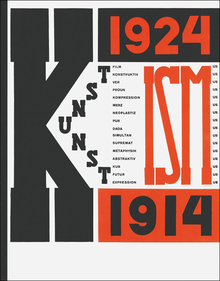
Carefully put together by El Lissitzky and Hans Arp, this 1920s publication illustrates the diversity of modern art movements from 1914 to 1924, including Constructivism, Verism, Prouns, Compressionism, Merzbild, Neo-plasticism, Purism, Dadaism, Simultaneity, Suprematism, Metaphysical Art, Abstraction, Cubism, Futurism and Expressionism. The result was Die Kunstismen, a surprisingly comprehensive yet still tongue-in-cheek survey featuring many of the major players of modern art. Through a geometrically arranged chronology evocative of De Stijl, Arp assembles a host of works by international artists, from Picasso, Braque and Mondrian to Man Ray, Alexander Archipenko, Tomoyoshi Murayama and Marc Chagall. Meanwhile, El Lissitzky’s bold red-and-black cover design signified the arrival of the avant-garde to Europe.
 Die Kunstismen / Les isms de l'art / The Isms of Art