Published by MFA Publications, Museum of Fine Arts, Boston. Text by Katie Hanson.
The Museum of Fine Arts, Boston, boasts one of the largest collections of the celebrated impressionist artist Claude Monet’s work outside France. This book reproduces all 35 oil paintings by Monet in the MFA’s permanent collection, representing nearly the full span of Monet’s long career. An introductory essay presents a brief account of his acclaim in Boston during his lifetime, and entries for the 35 paintings provide an overview of his life and work.
Early plein-air compositions from the 1870s, as well as Grand Canal, Venice (1908), a later example inspired by his travels abroad, mark his enduring fascination with watery surfaces, utilizing vivid color and varied brushwork to dazzling effect. A grouping of works related to his life-long appreciation for Japanese art and culture is anchored by La Japonaise (Camille Monet in Japanese Costume) (1876), a full-length portrayal of his wife Camille in a lavishly embroidered kimono. His 1875 composition Meadow with Poplars inspires another section, as its depiction of poppies, poplar trees and grain stacks foreshadows the recurrence of these themes in his painting throughout the decades to follow.
Claude Monet (1840-1926) trained with the plein-air painter Eugène Boudin among others, continuing his studies from 1859 onward in Paris, where he met Pissarro, Bazille, Sisley and Renoir. At their first exhibition in Paris in 1874, Monet’s painting Impression, soleil levant prompted critics to mockingly describe him as an impressionist.
Published by Hatje Cantz. Edited with text by Ulf Küster. Text by Maria Becker, Gottfried Boehm, Philippe Piguet, James Rubin, et al.
This fabulous celebration of light and color illustrates the artistic development of the great French painter from Impressionism to his late work, in the years between 1880 and the beginning of the 20th century. It features his Mediterranean landscapes, wild Atlantic coastal scenes, various stretches of the Seine, meadows with wild flowers and haystacks, water lilies, cathedrals and bridges shrouded in fog. Experimenting with changing light and color effects in the course of a day and in different seasons, Monet evoked magical moods through reflections and shadows, breaking loose from representational logic and the constraints of the pictorial object—an accomplishment this book highlights. Published for an exhibition at the Fondation Beyeler in Switzerland, Monet: Reflections and Shadows brings together 50 masterpieces from private collections and renowned museums such as the Musée d’Orsay in Paris, the Pola Museum in Japan, The Metropolitan Museum of Art in New York and the Art Institute of Chicago.
Claude Monet (1840–1926) trained with the plein-air painter Eugène Boudin among others, continuing his studies from 1859 onward in Paris, where he met Pissarro, Bazille, Sisley and Renoir. At their first exhibition in Paris in 1874, Monet’s painting Impression, soleil levant prompted critics to mockingly describe him as an impressionist.
Published by The Museum of Modern Art, New York. By Ann Temkin.
In 1955 MoMA became the first US museum to acquire one of Monet’s paintings of his garden in Giverny. This volume by Ann Temkin, Chief Curator of Painting and Sculpture at MoMA, recounts the history of Monet’s Water Lilies paintings at the Museum and underscores their resonance with the art of the last half-century.
Published by Royal Academy Publications. Text by Pia Valentinis. Illustrations by Giancarlo Ascari.
Claude Monet (1840–1926) was the famous French painter who created a grand and beautiful garden in Giverny, France, filling it with irises, poppies, roses, and, of course, water lilies, which he celebrated in his vast and glorious paintings. This new view of Monet and his garden will delight children and gently teach them about his art.
The book tells how the Impressionist artist arrived at his garden; about the bright Japanese prints he collected that inspired him; about his famous visitors; how he painted outdoors in all weathers; and about his gardeners, who had to leave Giverny to go to war. Spread by spread, the garden is explained and built up in Ascari’s and Valentinis’s original illustrations that take Monet’s work as their starting point and reimagine it in stunning and unusual ways.
Published by The Museum of Modern Art, New York. Text by Ann Temkin, Nora Lawrence.
Claude Monet (1840-1926) devoted the last 25 years of his career to paintings of the Japanese-style pond and gardens of his house in Giverny, France. Two of these luminous panels--"Reflections of Clouds on the Water-Lily Pond," a mural-sized triptych, and "Water Lilies," a single canvas--are among the most well-known and beloved works in the collection of The Museum of Modern Art. The aim of these paintings, according to the artist, was to supply "the illusion of an endless whole, of water without horizon or bank." These late works were for many years less appreciated than Monet's classic Impressionist works, oftentimes seen as unstructured, even unfinished. But with the emergence of Abstract Expressionism in the 1950s, Monet became an extraordinarily relevant predecessor. In 1955, The Museum of Modern Art became the first American museum to acquire one of Monet's large-scale water lily compositions. In 1958, when a fire destroyed this and another water lily painting, the public's widespread expression of loss led to the acquisition of the works currently in the collection. This lively volume recounts the history of Monet's water lilies at the Museum underscores the resonance of these paintings with the art and artists of the last half-century.
Published by Hatje Cantz. Essays by Roman Zieglgânsberger, Marion Bornscheuer, Christofer Conrad, Christian von Holst and Katja Matauschek.
These 40 paintings follow Claude Monet's progress through years of landscapes, tracking changes in his work and making the case that fields and meadows may have been his most revealing theme. Starting in 1873, Monet began painting the fields around Argenteuil with occasional human subjects--his first wife Camille and their small boy Jean--in close brushwork that brought out a vibrating tension, large-scale liveliness. The series of Seine landscapes upon which he embarked in 1878, around the area of Vetheuil, compared the river's untouched meadows to that cultivated farmland. Canvases from the spring of 1880 contain a particularly palpable joy on the renewal of the land after a very hard winter. And it was after relocating to Giverny in 1883--a move that coincided with the increasing establishment of the Impressionist movement as the most important development in French art of that era--that Monet painted the work from which this monograph takes its name, his 1887 Fields in Spring, with its crucially austere organization of surfaces and highly systematic palette. It was a turning point in his oeuvre, a mingling of severity and simplification that brought incomparably harmonious effect and the unbroken admiration of his colleagues. This concise study closes with the fascinating paintings of 1894 in which Monet perfected this systematic approach.
Published by Snoeck Publishers, Ghent. Essays by Dr. Jennifer Hardin and Prof. John House.
Monet's London: Artists' Reflections on the Thames intimately explores Expressionist Claude Monet's London series of paintings, especially those that immortalized the Thames River. In this volume we are invited to explore the scope of the socio-cultural context of that time, through the works of Monet's contemporaries: Derain, Coburn, Fenton, Pennell, and Whistler, to name a few. In the latter half of the 19th century, London, specifically around the Thames, had become a seductive urban landscape--a place that encouraged artists to create.
Not only does Monet's London document an important exhibition, but it is also the first publication to thoroughly document and discuss the artistic and cultural context of Modernist London (1859-1914), with special emphasis on the visual power of the Thames River.
PUBLISHER Snoeck Publishers, Ghent
BOOK FORMAT Paperback, 11.5 x 9.5 in. / 216 pgs / 94 color / 84 bw.
PUBLISHING STATUS Pub Date 4/15/2005 No longer our product
DISTRIBUTION D.A.P. Exclusive Catalog: SPRING 2005 p. 47
PRODUCT DETAILS ISBN 9789053495452TRADE List Price: $35.00 CDN $40.00

 Monet: Reflections and Shadows
 Claude Monet: Water Lilies
 The Garden of Monsieur Monet
 Claude Monet: Water Lilies
 Claude Monet: Fields in Spring
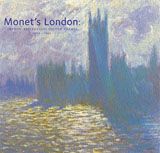 Monet's London